
Offense for Defense: The Art and Science of Cybersecurity Red Teaming 

“Embracing the principles of Cybersecurity Red Teaming not only fortifies an organization’s digital defenses but fosters a proactive mindset that is essential for thriving in the ever-evolving cyber threat landscape. It is through this strategic fusion of innovation, collaboration, and offense-for-defense tactics that we can truly safeguard our critical assets and ensure a more secure digital future.” – Dr. Kevin Lynn McLaughlin, PhD 

Abstract:    

The article delves into the methodologies, tools, techniques, and strategies employed in Red Teaming, as well as the planning practices that underpin successful engagements. The success of Red Teaming engagements depends on the expertise of the Red Teamers, who possess a comprehensive understanding of cybersecurity principles, technologies, and best practices. Furthermore, the article highlights the strategic application of cyber deception techniques, such as honeypots, honeynets, and decoy systems, to enhance an organization’s ability to identify and respond to emerging threats. The article also emphasizes the importance of the continuous improvement and adaptation of strategies and techniques in response to evolving threats and emerging technologies. In addition, the article underscores the collaborative and iterative approach of Red Teaming engagements, which ensures that organizations can effectively adapt to and mitigate the risks posed by an ever-evolving threat landscape. By meticulously documenting and analyzing instances where the Blue Team successfully intercepts the Red Team’s efforts, organizations can develop a comprehensive understanding of their security posture and make informed decisions to enhance their defenses. With the constant evolution of cyber threats, Red Teaming is becoming increasingly important, and organizations that embrace it will be better equipped to protect their critical assets and defend against the relentless onslaught of cyber threats.  

In the ever-evolving landscape of cyber warfare, the axiom “offense is the best defense” takes on a new meaning as organizations endeavor to secure their digital infrastructure from a relentless barrage of threats. To safeguard vital information assets and ensure the integrity of their networks, organizations must embrace the concept of offense for defense, a doctrine that champions the employment of adversarial tactics to identify and remediate vulnerabilities. This article delves into the realm of Cybersecurity Red Teaming, a disciplined and systematic approach that adopts offensive strategies to bolster defensive capabilities. It expounds on the methodologies, tools, techniques, and strategies employed in Red Teaming, as well as the planning practices that underpin successful engagements.  

Red Teaming, a term derived from the military, entails assembling a group of cybersecurity experts, aptly known as Red Teamers, who assume the role of sophisticated adversaries to simulate real-world cyber-attacks on an organization’s digital infrastructure. (I. & Kovačević and S. Groš, 2020) A foundational attribute of an outstanding Red Teamer is a comprehensive understanding of cybersecurity principles, technologies, and best practices. Acquired through rigorous education and continuous training, this knowledge equips them with the ability to navigate the intricacies of a target organization’s digital landscape. Their expertise extends beyond technical prowess, encompassing a deep comprehension of the organizational, legal, and ethical implications of their actions. The fast-paced and dynamic nature of cybersecurity demands that Red Team members possess an innate curiosity and an insatiable appetite for learning. This intellectual curiosity drives them to stay abreast of the latest developments in the field, engage with emerging technologies, and cultivate a profound understanding of the evolving tactics, techniques, and procedures employed by malicious actors. A commitment to lifelong learning enables Red Teamers to adapt to the ever-changing threat landscape and devise innovative strategies for identifying and exploiting vulnerabilities. In addition to technical acumen, exceptional Red Teamers are distinguished by their ability to think creatively and approach challenges with an unconventional mindset. This outside-the-box thinking is crucial for simulating the myriad of attack vectors that real-world adversaries might employ, as well as devising novel and unexpected strategies for breaching an organization’s defenses. By adopting a hacker’s mindset, Red Teamers can accurately gauge an organization’s ability to detect, respond, and recover from cyber-attacks, allowing them to recommend effective countermeasures and remediation strategies. (Marcus et al., 2019) Effective communication skills are paramount for Red Teamers, as they must be able to articulate their findings, insights, and recommendations to a diverse range of stakeholders within the target organization. This entails translating complex technical concepts into clear and concise language that can be understood by both technical and non-technical audiences. Furthermore, exceptional Red Teamers possess strong interpersonal skills, which enable them to collaborate effectively with their teammates and foster a spirit of cooperation and mutual support. The unique demands of Red Teaming engagements necessitate that Red Teamers exhibit a high degree of adaptability and resilience. The ability to thrive under pressure and remain focused in the face of setbacks is vital for navigating the plethora of challenges inherent in simulating cyber-attacks. A strong work ethic, combined with a commitment to professionalism and integrity, ensures that Red Teamers operate within the ethical and legal boundaries governing their activities, thereby upholding the trust placed in them by the target organization. An exceptional Red Team member possesses a diverse array of qualities, encompassing technical expertise, intellectual curiosity, creativity, effective communication, adaptability, and resilience. By cultivating these attributes and fostering a spirit of continuous learning and innovation, Red Teamers can drive organizations towards the development of more robust and resilient security architectures, ensuring the long-term protection of their critical assets.  

Red teaming is a powerful tool that enables organizations to assess their security posture from an attacker’s perspective. Unlike conventional security audits and assessments, red teaming involves engaging in simulated attacks on an organization’s systems and infrastructure. The goal of red teaming is to identify vulnerabilities and weaknesses that may have been overlooked by traditional security measures, and to develop more effective defense strategies. Red teaming is a highly effective way for organizations to gain valuable insights into their security posture. By simulating real-world attack scenarios, red teaming exercises can help organizations identify weaknesses in their defenses and develop more effective strategies for protecting their critical assets. A key benefit of red teaming is that it provides organizations with a more comprehensive view of their security posture.  

Traditional security assessments often focus on specific areas of an organization’s infrastructure or processes, but red teaming exercises take a more comprehensive approach. By simulating real-world attack scenarios, red team exercises can help organizations identify weaknesses and vulnerabilities across all areas of their operations. Another important benefit of red teaming is that it helps organizations develop more robust and resilient defenses. By identifying vulnerabilities and weaknesses, organizations can take proactive steps to address these issues and improve their overall security posture. This can include everything from implementing new security controls to improving employee training and awareness programs. Red teaming is a powerful tool that enables organizations to assess their security posture from an attacker’s perspective. By engaging in simulated attacks, organizations can gain valuable insights into their vulnerabilities and weaknesses and develop more effective strategies for protecting their critical assets. With the constantly evolving threat landscape, red teaming is becoming an increasingly vital component of any organization’s security strategy. A meticulous and comprehensive Red Teaming engagement necessitates an in-depth comprehension of the target organization’s objectives, assets, and threat landscape. The process commences with the reconnaissance phase, wherein the Red Team acquires intelligence pertaining to the organization’s infrastructure, systems, and personnel. This critical phase paves the way for the identification of potential attack vectors that the Red Team can exploit in the subsequent stages of the engagement. After the reconnaissance phase, the Red Team transitions to the planning phase. This essential phase involves the careful delineation of the scope, objectives, and rules of engagement for the Red Team. By defining these parameters, the planning phase ensures that the Red Team operates within ethical and legal boundaries while optimizing the efficacy of their offensive endeavors. Furthermore, this phase presents the Red Team with an opportunity to pinpoint any gaps or vulnerabilities in the target organization’s security posture that can be exploited in the later stages of the engagement (Everson, 2020). Upon completion of the planning phase, the Red Team embarks on the execution phase. During this stage, the Red Team employs an array of diverse tools, techniques, and methodologies to infiltrate the target organization’s systems, networks, and applications. Emulating the tactics, techniques, and procedures (TTPs) utilized by genuine adversaries, the Red Team’s strategies span from social engineering and spear-phishing campaigns to the exploitation of zero-day vulnerabilities and the leveraging of advanced persistent threats (APTs). The primary objective of the Red Team during the execution phase is to accurately assess the target organization’s capacity to detect, respond to, and recover from cyber-attacks. By mimicking the modus operandi of sophisticated threat actors, the Red Team can uncover weaknesses and vulnerabilities within the target organization’s security posture. This invaluable information is subsequently employed to recommend suitable countermeasures and remediation strategies. A comprehensive Red Teaming engagement is a multi-faceted process that demands a thorough understanding of the target organization’s objectives, assets, and threat landscape. The engagement unfolds through the reconnaissance phase, during which the Red Team gathers intelligence on the target organization, followed by the planning phase, where the scope, objectives, and rules of engagement are established. The execution phase ensues, where the Red Team utilizes a diverse assortment of tools, techniques, and methodologies to infiltrate the target organization’s systems and detect weaknesses and vulnerabilities (Veerasamy, 2009). The Red Team’s findings serve as the basis for recommending appropriate countermeasures and remediation strategies. 

A potential vital aspect of successful Red Teaming engagements lies in the strategic application of cyber deception techniques to conquer and derail blue team defenses and to entice bad actors into their environment so that they can view real attack activity and learn from it. By employing an array of sophisticated deception mechanisms, such as honeypots, honeynets, and decoy systems, Red Teams can entice malicious actors into controlled environments. This enables the target organization to meticulously study the attacker’s tactics, collect valuable intelligence on emerging threats, and develop countermeasures to protect their critical assets. (Han et al., 2018) This intelligence-driven approach to cybersecurity cultivates a proactive mindset, empowering organizations to stay one step ahead of malicious actors in the ever-changing cyber threat landscape. Moreover, the continuous improvement and adaptation of strategies and techniques in response to evolving threats and emerging technologies are essential components of Red Teaming. This necessitates that Red Teamers remain abreast of the latest developments in cybersecurity, engage in continuous education and training, and cultivate a profound understanding of the intricacies of the digital domain.  

By fostering a culture of innovation and collaboration, Red Teamers can propel organizations towards the development of more robust and resilient security architectures, ensuring the long-term protection of their critical assets. Another crucial aspect of Red Teaming engagements is the documentation and analysis of instances where the Blue Team, responsible for defending the organization, successfully detects and thwarts the Red Team’s endeavors. This process involves the Red Team meticulously capturing, in their reports, the precise points at which the Blue Team’s defenses caught them in their tracks. By scrutinizing these encounters, both the Red and Blue Teams can identify the strengths and weaknesses of the organization’s security posture, as well as devise improvements and refinements to fortify their defenses. This collaborative and iterative approach ensures that organizations can effectively adapt to and mitigate the risks posed by an ever-evolving threat landscape. The strategic application of cyber deception and the continuous improvement of strategies and techniques are paramount to the success of Red Teaming engagements. By employing sophisticated deception mechanisms and fostering a culture of innovation and collaboration, Red Teamers can help organizations stay ahead of malicious actors and ensure the long-term protection of their critical assets. Furthermore, by meticulously documenting and analyzing instances where the Blue Team successfully intercepts the Red Team’s efforts, organizations can develop a comprehensive understanding of their security posture and make informed decisions to enhance their defenses against an increasingly complex and dynamic cyber threat landscape. 

In the ever-evolving domain of cybersecurity, red teams repeatedly strive to refine their methodologies and employ cutting-edge tools to maintain an edge over their adversaries. One such innovation that has been embraced by the cybersecurity community is the integration of Security Orchestration, Automation, and Response (SOAR) automation with automated emulation software. This confluence of technologies engenders a synergistic effect that equips red teams with the ability to execute their operations with a higher degree of efficiency, precision, and adaptability.  SOAR platforms are able to dynamically analyze and synthesize vast quantities of data, thereby enabling red teams to swiftly identify potential vulnerabilities and formulate appropriate countermeasures. Furthermore, these platforms facilitate the automation of routine tasks and the orchestration of disparate security tools, which, in turn, liberates the red team members from the burden of mundane activities and empowers them to focus on more strategic and cognitively demanding undertakings.  The field of automated emulation software also embodies a potent instrument that is designed to replicate the modus operandi of a diverse array of adversaries, ranging from sophisticated nation-state actors to malicious insiders (Applebaum et al., 2016). Through the meticulous emulation of the tactics, techniques, and procedures (TTPs) employed by these threat actors, red teams are afforded the opportunity to gain valuable insights into the way in which their defenses might be circumvented. Additionally, automated emulation software can be utilized to conduct continuous and iterative assessments of an organization’s cybersecurity posture, thereby ensuring that any emergent vulnerabilities are expeditiously identified and addressed. The confluence of SOAR automation and automated emulation software engenders a potent amalgamation that imbues red teams with the cost-effective capacity to confront the challenges presented by the contemporary threat landscape. By leveraging the dynamic analytical and decision-making capabilities offered by SOAR platforms, red teams can seamlessly integrate the insights gleaned from automated emulation software, thereby fostering the creation of a holistic and adaptive defense through offense strategy.  The marriage of SOAR automation and automated emulation software constitutes a formidable alliance that can help to revolutionize the way red teams execute their mission-critical responsibilities. By harnessing the power of these technologies, red teams can overcome the limitations of, and excessive costs associated with traditional red team methodologies. 

In conclusion, Red Teaming is a critical component of an organization’s cybersecurity strategy, enabling them to assess their security posture from an attacker’s perspective. Red Teaming involves the simulated attack of an organization’s systems and infrastructure, allowing for the identification of vulnerabilities and weaknesses that may have been overlooked by traditional security measures. This approach allows organizations to develop more effective defense strategies that can protect their critical assets from the relentless barrage of cyber threats. The success of a Red Teaming engagement hinges on the expertise of the Red Teamers, who possess a comprehensive understanding of cybersecurity principles, technologies, and best practices. In addition to technical expertise, Red Teamers must possess creative thinking, effective communication, and collaboration skills, as well as adaptability and resilience, to navigate the complex and dynamic cybersecurity landscape. They must also remain abreast of the latest developments in the field and cultivate a profound understanding of the evolving tactics, techniques, and procedures employed by malicious actors. Furthermore, the strategic application of cyber deception techniques, such as honeypots, honeynets, and decoy systems, can enhance an organization’s ability to identify and respond to emerging threats. The continuous improvement and adaptation of strategies and techniques in response to evolving threats and emerging technologies are also essential components of Red Teaming engagements. In addition, the collaborative and iterative approach of Red Teaming engagements ensures that organizations can effectively adapt to and mitigate the risks posed by an ever-evolving threat landscape. By meticulously documenting and analyzing instances where the Blue Team successfully intercepts the Red Team’s efforts, organizations can develop a comprehensive understanding of their security posture and make informed decisions to enhance their defenses. Red Teaming is a powerful tool that can help organizations develop more robust and resilient security architectures, ensuring the long-term protection of their critical assets. By embracing the concept of offense for defense, organizations can stay one step ahead of malicious actors in the ever-changing cyber threat landscape. To further bolster the effectiveness of Red Teaming, cybersecurity SOAR automation and software emulation programs have emerged as valuable tools. SOAR (Security Orchestration, Automation, and Response) automation can help Red Teams streamline their processes and automate repetitive tasks, allowing them to focus on high-value activities such as identifying new attack vectors and developing countermeasures. Meanwhile, software emulation programs can help Red Teams accurately replicate real-world attack scenarios, enabling them to more effectively gauge an organization’s ability to detect, respond to, and recover from cyber-attacks. With the constant evolution of cyber threats, Red Teaming is becoming increasingly important, and organizations that embrace it will be better equipped to protect their critical assets and defend against the relentless onslaught of cyber threats. 

References 

Applebaum, A., Miller, D., Strom, B., Korban, C., & Wolf, R. (2016). Intelligent, automated red team emulation Proceedings of the 32nd Annual Conference on Computer Security Applications, Los Angeles, California, USA. https://doi.org/10.1145/2991079.2991111 


Everson, D. a. C. L. (2020). Network Attack Surface Simplification for Red and Blue Teams   


Han, X., Kheir, N., & Balzarotti, D. (2018). Deception Techniques in Computer Security: A Research Perspective. ACM Comput. Surv., 51(4), Article 80. https://doi.org/10.1145/3214305  


I., & Kovačević and S. Groš. (2020). Pentesters, APTs, or Neither 43rd International Convention on Information, Communication and Electronic Technology (MIPRO), Opatija, Croatia.  


Marcus, Carey, J., & Jin, J. (2019). , “Tinker Secor,” in Tribe of Hackers Red Team: Tribal Knowledge from the Best in Offensive Cybersecurity Wiley. https://doi.org/doi:10.1002/9781119643357.ch37  

Veerasamy, N. (2009). High-Level Methodology for Carrying out Combined Red and Blue Teams   

ORCID – https://orcid.org/0009-0009-8367-5292

DEFENSE IS THE BEST OFFENSE: THE EVOLVING ROLE OF CYBERSECURITY BLUE TEAMS AND THE IMPACT OF SOAR TECHNOLOGIES

ABSTRACT. The article delves into the intricacies, tools, approaches, and tactics utilized by Cybersecurity Blue Teams, as well as the essential planning practices that lay the foundation for successful operations. The effectiveness of Blue Team operations relies on the proficiency of the Blue Team members, who possess an all-encompassing understanding of cybersecurity principles, technologies, and best practices. Moreover, the article accentuates the tactical implementation of cyber defense mechanisms, such as honeypots, honeynets, and decoy systems, to augment an organization’s capacity to detect and react to emerging threats. A key aspect of the article is the exploration of how Security Orchestration, Automation, and Response (SOAR) technologies support Blue Teams in enhancing their capabilities. SOAR technologies streamline and automate the response process, enabling Blue Teams to quickly identify, investigate, and remediate threats, thereby reducing the time taken to react and strengthening overall security posture. The article also stresses the significance of continuous improvement and adaptation of strategies and techniques in response to the ever- changing threat landscape and emerging technologies. In addition, the article underlines the cooperative and iterative nature of Blue Teaming operations, ensuring that organizations can efficiently adapt to and alleviate the risks posed by a perpetually evolving cyber environment. By scrupulously documenting and examining instances where the Blue Team effectively thwarts the Red Team’s efforts, organizations can cultivate a comprehensive understanding of their security posture and make informed decisions to bolster their defenses. As cyber threats continuously evolve, the role of Cybersecurity Blue Teams is becoming increasingly vital, and organizations that embrace this proactive approach, supported by advanced technologies such as SOAR, will be better prepared to safeguard their critical assets and resist the unyielding barrage of cyber threats.

“Embracing the dynamic interplay between Blue Teams and cutting-edge SOAR technologies is the cornerstone of an agile and robust cybersecurity strategy for organizations navigating the ever-evolving threat landscape.”

– Kevin Lynn McLaughlin, PhD

In the ever-evolving landscape of cybersecurity, the axiom “defense is the best offense” takes on new meaning as organizations endeavor to secure their digital infrastructure from a relentless barrage of threats. To safeguard vital information assets and ensure the integrity of their networks, organizations must embrace the concept of defense through preparedness, a doctrine that champions the employment of proactive tactics to identify and remediate vulnerabilities. This article delves into the realm of Cybersecurity Blue Teaming, a disciplined and systematic approach that adopts defensive strategies to bolster an organization’s security posture. It expounds on the methodologies, tools, techniques, and strategies employed by Blue Teams, as well as the planning practices that underpin successful engagements. Blue Teaming, a term derived from the military, entails assembling a group of cybersecurity experts, aptly known as Blue Teamers, who assume the role of vigilant defenders to protect an organization’s digital infrastructure. A foundational attribute of an outstanding Blue Teamer is a comprehensive understanding of cybersecurity principles, technologies, and best practices. Acquired through rigorous education and continuous training, this knowledge equips them with the ability to navigate the intricacies of an organization’s digital landscape. Their expertise extends beyond technical prowess, encompassing a deep comprehension of the organizational, legal, and ethical implications of their actions. The fast-paced and dynamic nature of cybersecurity demands that Blue Team members possess an innate curiosity and an insatiable appetite for learning. This intellectual curiosity drives them to stay abreast of the latest developments in the field, engage with emerging technologies, and cultivate a profound understanding of the evolving tactics, techniques, and procedures employed by malicious actors. A commitment to lifelong learning enables Blue Teamers to adapt to the ever-changing threat landscape and devise innovative strategies for identifying and mitigating vulnerabilities. 

 
In addition to technical acumen, exceptional Blue Teamers are distinguished by their ability to think analytically and approach challenges with a methodical mindset. This structured thinking is crucial for understanding the myriad of attack vectors that real-world adversaries employ. This skill set also assists in devising comprehensive and effective strategies for defending an organization’s systems. By adopting a defender’s mindset, Blue Teamers can accurately gauge an organization’s ability to detect, respond, and recover from cyber-attacks, allowing them to recommend effective countermeasures and remediation strategies. To enhance their proficiency and expertise, Blue Team members should participate in various types of training and utilize a well-designed training infrastructure. Some of the best practices for training infrastructure and the types of training that Blue Team members should be engaged in include: 

  1. Cybersecurity Training Labs: Establishing dedicated cybersecurity training labs where Blue Team members can practice their skills in a safe and controlled environment. These labs should replicate real-world scenarios and include diverse systems, networks, and security tools that the Blue Teamers will encounter during their day-to-day activities. 
  1. Cyber Range Exercises: Participating in cyber range exercises where Blue Teamers can hone their skills by engaging in simulated cyber-attacks and incident response scenarios. These exercises provide a realistic, hands-on environment for Blue Team members to develop their expertise and learn how to effectively respond to various types of cyber threats. (Li & Xie, 2016) 
  1. Online Training Platforms: Leveraging online training platforms and cybersecurity courses to expand their knowledge and stay up to date with the latest developments in the field. These platforms offer a wide range of topics and allow Blue Team members to learn at their own pace, catering to different levels of expertise. 
  1. Industry Certifications: Encouraging Blue Team members to pursue industry certifications such as CompTIA Security+, Certified Information Systems Security Professional (CISSP), and Certified Ethical Hacker (CEH). These certifications validate their skills and knowledge, demonstrating their commitment to continuous learning and professional development (Kwon et al., 2012). 
  1. Workshops and Conferences: Attending cybersecurity workshops and conferences where Blue Team members can learn from experts, share their experiences, and network with their peers. These events provide valuable insights into the latest trends, tools, and techniques in the cybersecurity landscape, helping Blue Teamers to stay informed and adapt their strategies accordingly. 
  1. Internal Knowledge Sharing: Fostering a culture of internal knowledge sharing within the Blue Team, where members can exchange information, experiences, and lessons learned from past engagements. Regular team meetings, presentations, and informal discussions can help Blue Teamers learn from one another and improve their collective expertise. 
  1. Collaboration with Red Teams: Engaging in joint training exercises and simulations with Red Teams, where Blue Teamers can learn about the latest attack techniques and methodologies employed by adversaries. This collaboration helps Blue Team members develop a deeper understanding of potential threats and vulnerabilities, allowing them to devise more effective defensive strategies. 

By participating in these diverse training opportunities and employing a robust training infrastructure, Blue Team members can continuously enhance their skills and expertise. This commitment to lifelong learning and professional development is essential for Blue Teamers to stay ahead of the ever-evolving cybersecurity landscape, enabling them to protect their organizations more effectively and efficiently. 

 Effective communication skills are paramount for Blue Teamers, as they must be able to articulate their findings, insights, and recommendations to a diverse range of stakeholders within the organization. This entails translating complex technical concepts into clear and concise language that can be understood by both technical and non-technical audiences. Exceptional Blue Teamers possess strong interpersonal skills, which enable them to collaborate effectively with their teammates and foster a spirit of cooperation and mutual support. The unique demands of Blue Team operations necessitate that Blue Teamers exhibit a high degree of adaptability and resilience. The ability to thrive under pressure and remain focused in the face of setbacks is vital for navigating the plethora of challenges inherent in defending against cyber-attacks. A strong work ethic, combined with a commitment to professionalism and integrity, ensures that Blue Teamers operate within the ethical and legal boundaries governing their activities, thereby upholding the trust placed in them by the organization. An exceptional Blue Team member possesses a diverse array of qualities, encompassing technical expertise, intellectual curiosity, analytical thinking, effective communication, adaptability, and resilience. By cultivating these attributes and fostering a spirit of continuous learning and innovation, (Rege, 2016) Blue Teamers can drive organizations towards the development of more robust and resilient cybersecurity architectures, ensuring the long-term protection of their critical assets. 

In the ever-evolving landscape of cybersecurity, focusing on defense through preparedness is essential as organizations strive to secure their digital infrastructure against a relentless barrage of threats. Embracing proactive tactics to identify and remediate vulnerabilities is a core aspect of a cybersecurity Blue Team’s approach. Continuous monitoring and threat detection are critical aspects of a Blue Team’s defensive strategy. Blue Teams should establish a comprehensive monitoring and threat detection system across the organization’s infrastructure, systems, and networks using tools such as Security Information and Event Management (SIEM) systems, Intrusion Detection Systems (IDS), and network monitoring solutions (Everson, 2020). To further enhance their capabilities, Blue Teams should consider incorporating a Detection Engineering role into their team structure. A Detection Engineer is a specialized role that focuses on designing, developing, and implementing advanced threat detection and monitoring solutions to strengthen the organization’s security posture. They are responsible for creating custom detection rules, signatures, and indicators of compromise (IOCs) that can effectively identify and respond to a wide range of cyber threats. The Detection Engineering role provides a Blue Team with several key benefits, including improved threat detection. Detection Engineers bring expertise in identifying the latest threats, enabling the Blue Team to detect and respond to attacks more quickly and accurately. They use their knowledge of attacker tactics, techniques, and procedures (TTPs) to create custom detection rules that can identify even the most advanced and stealthy threats. Detection Engineers also contribute to tailored monitoring solutions by working closely with the Blue Team to understand the organization’s unique security needs and develop monitoring solutions that align with the organization’s risk profile. This ensures that the detection capabilities are optimized for the specific threats and vulnerabilities the organization faces. Moreover, Detection Engineers enhance the integration and configuration of SIEM and IDS tools to maximize their effectiveness. They can fine-tune these tools to reduce false positives and false negatives, ensuring that alerts are more relevant and actionable for the Blue Team. Continuous improvement is another aspect of the Detection Engineering role. Detection Engineers continually assess and refine the organization’s detection capabilities by analyzing the effectiveness of existing rules, signatures, and IOCs. They identify gaps in coverage and make necessary adjustments to improve detection accuracy and reduce the time it takes to detect and respond to threats. Detection Engineers also utilize threat intelligence feeds and sharing platforms to stay informed about the latest threats, vulnerabilities, and attack trends. They use this information to update and enhance the organization’s detection capabilities, ensuring that the Blue Team is prepared for emerging threats. The Detection Engineering role fosters cross-team collaboration, as Detection Engineers work closely with other cybersecurity roles, such as Incident Responders, Threat Analysts, and Red Teamers, to share insights and improve the organization’s overall security posture. This collaboration helps create a more effective and cohesive defense strategy. Incorporating a Detection Engineering role within a Blue Team significantly enhances the team’s ability to detect and respond to cyber threats. By creating custom detection rules, optimizing monitoring solutions, and continuously improving the organization’s detection capabilities, Detection Engineers play a crucial role in strengthening the organization’s cybersecurity defenses and ensuring the long-term protection of its critical assets. 

Developing and maintaining incident response plans is another best practice. Blue Teams should create, regularly review, and update incident response plans to ensure their effectiveness and relevance. These plans should outline the roles and responsibilities of team members, as well as the procedures for detecting, analyzing, containing, eradicating, and recovering from security incidents. Conducting regular security audits and assessments is essential for identifying vulnerabilities, misconfigurations, and areas for improvement. These assessments should cover the organization’s infrastructure, applications, policies, and procedures, as well as employee awareness and training programs. Collaborating with Red Teams during simulated attack scenarios allows Blue Teams to gain valuable insights into potential weaknesses in their defenses. This collaboration helps both teams identify areas that need improvement and develop more effective strategies for protecting critical assets. 

Leveraging threat intelligence is a vital aspect of a proactive defense strategy. Utilizing threat intelligence feeds and sharing platforms can help Blue Teams stay informed about the latest threats, vulnerabilities, and attack trends, which can be used to proactively adapt defenses, develop effective countermeasures, and improve the overall security posture. Implementing defense-in-depth strategies is an essential component of a robust cybersecurity posture. Blue Teams should adopt a layered approach to security, ensuring that multiple layers of defense are in place to protect the organization’s assets. This includes deploying firewalls, intrusion prevention systems, access control mechanisms, encryption, and endpoint protection solutions. One area that should not be overlooked is that regularly updating and patching systems are crucial for mitigating vulnerabilities and reducing the attack surface. Blue Teams should establish a patch management process to ensure that systems are consistently updated in a timely manner. Finally, testing and validating backups help ensure that data can be recovered in the event of a security incident or system failure. 

As the cybersecurity landscape evolves, Blue Teams need to be proactive and vigilant in detecting and thwarting Red Team’s endeavors. When Red Teams meticulously document instances where Blue Team successfully intercepts their efforts, both teams can work together to identify the strengths and weaknesses of the organization’s security posture. This collaborative and iterative approach enables organizations to adapt and mitigate risks posed by an ever-evolving threat landscape. As the complexity of the cybersecurity landscape grows, Blue Teams are increasingly relying on innovative technologies to safeguard their organizations’ digital infrastructure. One such technology, Security Orchestration, Automation, and Response (SOAR), has emerged as a powerful asset for Blue Teams in managing diverse security tools and streamlining Incident Response (IR) processes. Leveraging SOAR technologies, Blue Teams can consolidate various tools into a unified work queue or dashboard, providing them with a comprehensive and centralized view of their security posture. Deception technologies also play a crucial role in enhancing Blue Teams’ capabilities (Heckman, 2015). These technologies create realistic decoys and traps within the network to deceive and detect attackers, ultimately allowing for quicker identification and response to threats. The use of deception technologies can significantly reduce the attacker’s dwell time and strengthen the overall security posture. By integrating multiple tools, including deception technologies, into a single platform, Blue Teams can ensure efficient collaboration, data sharing, and decision-making across the entire security ecosystem. This integration not only simplifies the monitoring process but also enhances the ability to quickly detect and respond to potential threats. Another significant advantage of employing SOAR technology lies in its capacity to automate basic IR response for different types of attacks. By automating repetitive and time-consuming tasks, Blue Teams can focus their efforts on more strategic and cognitively demanding responsibilities, such as threat hunting and advanced incident analysis. Furthermore, automation reduces the potential for human error, ensuring that the organization’s security posture remains robust and consistent. In addition to automation, SOAR technology also aids in streamlining the handling of verbose monitoring data. With the vast amount of data generated by diverse security tools, it is crucial for Blue Teams to effectively manage and analyze this information to identify potential threats and vulnerabilities. SOAR platforms excel in this domain by applying advanced analytics, machine learning, and correlation techniques to distill actionable insights from massive volumes of data. This empowers Blue Teams to swiftly detect and respond to threats, thereby enhancing the organization’s overall security posture. In essence, by embracing innovative technologies like SOAR and deception, Blue Teams can ensure the long-term protection of their organizations against an increasingly complex and dynamic cyber threat landscape. 

In conclusion, adopting a defender’s mindset and engaging in continuous training and skill development is essential for Blue Team members to effectively protect their organizations from the ever-evolving cybersecurity threats. By utilizing diverse training opportunities, fostering a culture of knowledge sharing, and collaborating with Red Teams, Blue Teamers can enhance their proficiency and expertise in the field. The implementation of a comprehensive monitoring and threat detection system, the incorporation of specialized roles such as Detection Engineers, and the development of robust incident response plans further strengthen an organization’s security posture. Proactive defense strategies, including leveraging threat intelligence, employing defense-in-depth tactics, and timely patch management, ensure a more resilient cybersecurity infrastructure. The use of cutting-edge technologies such as SOAR further empowers Blue Teams by streamlining their Incident Response processes and enhancing their ability to detect and respond to threats. By embracing a proactive and collaborative approach, Blue Teams can work in tandem with Red Teams to identify and mitigate risks in an ever-changing threat landscape. Ultimately, the relentless pursuit of knowledge, innovation, and collaboration will enable Blue Teams to better safeguard their organizations and ensure the long-term protection of their critical assets. 

ORCID

Kevin Lynn McLaughlin  http://orcid.org/0009-0009-8367- 5292

REFERENCES

Everson, D., & Long, C. (2020). Network attack surface simplifi- cation for red and blue teams. In 2020 IEEE Secure Development (SecDev).

Heckman, K. E., Stech, F. J., Schmoker, B. S., & Thomas, R. K. (2015). Denial and deception in cyber defense. Computer, 48(4), 36–44. https://doi.org/10.1109/MC.2015.104

Kwon, M., Jacobs, M. J., Cullinane, D., Ipsen, C. G., & Foley, J. (2012). Educating cyber professionals: A view from academia, the private sector, and government. IEEE Security & Privacy, 10 (2), 50–53. https://doi.org/10.1109/MSP.2012.36

Li, Y., & Xie, M. (2016). Platoon: A virtual platform for team-oriented cybersecurity training and exercises. In Proceedings of the 17th Annual Conference on Information Technology Education. https:// doi.org/10.1145/2978192.2978230

Rege, A. (2016). Incorporating the human element in anticipatory and dynamic cyber defense. In 2016 IEEE International Conference on Cybercrime and Computer Forensic (ICCCF).

ORCID – https://orcid.org/0009-0009-8367-5292

SECURING CORPORATE IoT DEVICES: CHALLENGES, STRATEGIES, AND THE ROLE OF AI AND ML IN CYBERSECURITY

The rapid proliferation of IoT devices within corporate infrastructures has left organizations more vulnerable than ever to cyberattacks. It is essential to adopt a comprehensive approach that incorporates various techniques, tools, and emerging technologies, such as AI and ML, to effectively defend against these evolving threats. – Dr. Kevin Lynn McLaughlin, PhD 

As the Internet of Things (IoT) continues to grow and proliferate, it is increasingly clear that IoT devices pose a significant cybersecurity risk to organizations. (Fazel et al., 2022) One of the primary challenges it poses is that it can be difficult to obtain relevant cybersecurity alert data from these devices into a corporate Security Information and Event Management (SIEM) system. As a result, cyberattacks that target IoT devices are often not detected by corporate cybersecurity Security Operations Centers (SOCs) in time for an effective response to be launched early in the attackers’ kill chain. Many IoT devices lack the ability to generate cybersecurity alert data in a format that can be easily consumed by a SIEM. For example, some IoT devices may only provide basic telemetry data that does not include information about cybersecurity events, making it difficult to distinguish normal behavior from malicious activity or abnormal behavior. In addition, many IoT devices are designed to operate independently and may not be able to communicate with a central monitoring system, making it difficult to detect anomalies and respond to threats in real-time.  

To address the multifaceted challenges posed by the integration of IoT devices within corporate infrastructures, it is imperative for organizations to adopt a diverse array of techniques, processes, and cybersecurity tools. These measures are designed to prevent, monitor, and detect any abnormal behavior exhibited by the IoT devices operating within their networks. A fundamental technique to consider is the implementation of network segmentation, which necessitates the division of the overarching corporate network into smaller, more manageable subnetworks. This approach effectively limits the potential impact resulting from a compromised IoT device, simultaneously impeding the ability of attackers to move laterally within the network and diminishing the risk of data exfiltration. Furthermore, organizations should prioritize the implementation of security controls at the device level. This can encompass a variety of measures, including the deactivation of unused services and ports, the diligent updating of firmware and software, and the careful configuration of access controls to restrict device access to authorized personnel only. Additionally, organizations can leverage network access control (NAC) technologies as a means of enforcing stringent policies regarding the types of devices permitted to connect to the corporate network, as well as the levels of access granted to each. By adopting this comprehensive strategy, organizations can significantly reduce the likelihood of unauthorized devices appearing in various locations, such as conference rooms, break rooms, and employee offices, which might otherwise be connected to the corporate infrastructure without proper oversight. In doing so, organizations will be better equipped to safeguard their networks and valuable data from the ever-evolving threats targeting IoT devices. 

In the pursuit of effectively monitoring and detecting IoT devices within an organization’s network, it is crucial to harness the power of the corporate cybersecurity Security Orchestration, Automation, and Response (SOAR) team. By leveraging the expertise of these professionals, organizations can design and implement strategies and solutions tailored to detecting abnormal behaviors originating from IoT devices, ultimately strengthening their cybersecurity posture.  A plethora of cybersecurity tools are available to aid organizations in monitoring and detecting IoT devices, encompassing IoT device discovery and inventory tools, network traffic analysis tools, and endpoint detection and response (EDR) tools. When used effectively, these tools enable organizations to pinpoint IoT devices on the network, scrutinize network traffic for any suspicious activity, and identify as well as respond to security incidents in real-time. The SOAR team in conjunction with your Cybersecurity Architects and Cybersecurity integration engineers can play a crucial role in optimizing the deployment and configuration of these tools, ensuring that they work in concert to provide comprehensive visibility and protection against threats targeting IoT devices. 

Artificial intelligence (AI), machine learning (ML) and blockchain technologies (Yu, 2018) (Dey, 2021) are also becoming increasingly indispensable in the defense of corporate IoT devices. These innovative technologies can augment the capabilities of the SOAR team by providing advanced analytics and automation. For instance, ML algorithms can be utilized to analyze network traffic, detecting anomalies that could potentially signify a cybersecurity threat. By incorporating these technologies into the organization’s cybersecurity strategy, the SOAR team can more effectively identify and prioritize potential threats, empowering them to focus their efforts on the most pressing concerns. In addition to bolstering threat detection, monitoring, detection and alerting AI can be harnessed to automate incident response processes, allowing organizations to react more swiftly and efficiently in the face of an attack. The SOAR team can take advantage of AI-driven automation to streamline workflows, reduce response times, and minimize the impact of security incidents on the organization’s operations and reputation. The corporate cybersecurity SOAR team plays a pivotal role in the creation and implementation of strategies aimed at detecting abnormal behaviors originating from IoT devices. By leveraging a diverse array of cybersecurity tools, as well as incorporating AI and ML technologies into their arsenal, the SOAR team can significantly enhance an organization’s ability to identify, monitor, and respond to the growing array of threats targeting IoT devices within their corporate infrastructure. 

In conclusion, the proliferation of IoT devices within corporate environments presents an array of complex cybersecurity challenges, rendering organizations increasingly vulnerable to cyberattacks. To counteract these evolving threats, a comprehensive approach is necessary (S. Forsström, 2018), incorporating a diverse range of techniques, processes, and cybersecurity tools, as well as harnessing the power of emerging technologies such as AI and ML. By leveraging the expertise of the corporate cybersecurity SOAR team, Cybersecurity Architects, and Cybersecurity Integration Engineers, organizations can develop and implement tailored strategies to effectively monitor, detect, and respond to abnormal behaviors originating from IoT devices. This collaborative and multifaceted approach is crucial in safeguarding corporate networks and valuable data from the ever-growing threats targeting IoT devices. As I stated at the start of this article, “It is essential to adopt a comprehensive approach that incorporates various techniques, tools, and emerging technologies, such as AI and ML, to effectively defend against these evolving threats.”(Zaman, 2021) By embracing this holistic strategy, organizations can significantly enhance their cybersecurity posture, mitigating the risks associated with the integration of IoT devices within their corporate infrastructures. 

References: 

Dey, A., Jara, A.J., Al-Jaroodi, J. (2021). Blockchain-based security and privacy in Internet of Things: A survey. Journal of Network and Computer Applications, 173. https://doi.org/https://doi.org/10.1016/j.jnca.2021.102837  

Fazel, E., Shayan, A., & Mahmoudi Maymand, M. (2022). Designing a model for the usability of fog computing on the internet of things. Journal of Ambient Intelligence and Humanized Computing. https://doi.org/10.1007/s12652-021-03501-5  

S. Forsström, I. B., M. Eldefrawy, U. Jennehag and M. Gidlund. (2018). Challenges of Securing the Industrial Internet of Things Value Chain Workshop on Metrology for Industry 4.0 and IoT, Brescia Italy.  

Yu, Y. (2018). Blockchain-Based Solutions to Security and Privacy Issues in the Internet of Things. IEEE Wireless Communications, 25(6), 12-18. https://doi.org/doi: 10.1109/MWC.2017.1800116  

Zaman, S. (2021). Security Threats and Artificial Intelligence Based Countermeasures for Internet of Things Networks: A Comprehensive Survey. IEEE Access, 9, 94668-94690. https://doi.org/doi: 10.1109/ACCESS.2021.3089681  

ORCID – https://orcid.org/0009-0009-8367-5292

Small and Medium Size Organizations at Risk

The bad guys are now starting to target mid-tier companies with their hacking activities.  In many cases these companies have not yet come to realize that having a Certified Chief Information Security Officer (C|CISO) or a Virtual Cerified|CISO (vC|CISO) is something that needs to be accepted as a part of doing business.  The recent Presidential report on how Cyber Attacks impact the economy of the U.S.A. makes it clear that the cost of having a security expert on staff or on retainer is well worth it if the smaller company wants to remain in business.  Cyber crime is putting many of these smaller companies out of business simply because they cannot recover from the post breach losses.   At the same time these companies may not have the dollars to pay for a full time C|CISO, so their alternative is to explore the vC|CISO concept.  The vC|CISO model can be leveraged to effectively manage security risk for small to mid-tier companies.

If a company is going to explore the hiring of a vC|CISO they need to make sure to do their due diligence and ask about the certifications (such as the one in the graphic below) and experience of the vC|CISO they are going to have giving them advice.  While there are a lot of good vC|CISO options available there are just as many vendors and security professionals touting themselves as vCISO’s who lack the background or experience to be of much help.  I lack quantifiable data on this point but I would say you should expect to pay between 3 and 400.00 per hour for a vC|CISO, the good news is you can choose what % of their time you want them to work for you (10%, 20%, on retainer, etc.) and then only pay for that portion of time.

Certified CISO

The Office of No, Really?

No  Successful ransomware attacks are at an all time high, we are losing the cyberwar, cyber criminals are making more money than ever before and it is only going to get worse, a cyber attack could be as damaging as a nuclear war – the headlines abound with comments such as this.   Yet, there are still a lot of postings about how information security should not be the office of No.   Really?  Information security is a security function,  as an information security professional are you really going to say – Yes, sure, go ahead and port that un-scanned software code into our production environment?  I would hope you are going to say no you cannot port that un-scanned software code into our production environment.  No is not a bad word, it is one that the job requires us to say.   If you are offended when someone says you are the office of No- don’t be.  To be a security professional no is a good response.  I train my team members to say “yes, but” in order to soften the perceived impression of the word no …..  (here’s a clue – “yes, but”  is still a no – no matter how you spin it).

However,  I have yet to sit in a business meeting and see any of my peers simply say no without being willing to engage in dialogue that would lead to a good and secure solution.   So for those who don’t like to say no then do it this way – yes you can put that server with 2 catastrophic exploitable vulnerabilities into the environment after we help you remediate the vulnerabilities or work on additional adequate controls that will allow us to use the server in a safe and secure manner.    For me, information security professionals can and should say no,  but after doing so we need to be helpful and smart enough to engage in conversations that help the business figure out how to do what they want to do in a way that is cost effective, safe and secure.

In many ways with the types and amount of successful attacks we are experiencing across the U.S. infrastructure being the office of Yes is a far more scary response than saying No to items that put your business at risk.

For Cyber Security the Perimeter Still Exists and Never Went Away


One item that really bugs me is to hear IT and Cyber Security professionals espouse that the perimeter is dead and that Cyber Security professionals should stop focusing on tools that protect the non-existing perimeter.   I was at a lunch with a fellow CISO a few months back and he had invited his CIO to lunch with us.   The CIO had recently attended a seminar where they talked about the perimeter no longer existing and he was truly wondering if he could just get rid of his firewalls.  It was a fun conversation but also a bit scary to me that the conversation actually had to take place.  The reality is that while the perimeter has changed we still host most of our systems and data in a data center or in multiple data centers and whether these data centers are on premise or in the cloud they still have a perimeter that needs protected.  Bad actors, both external and internal need to be kept out of areas they have no business being in.  To do that requires a strong perimeter consisting of next-generation firewalls such as the ones Palo Alto  or CISCO provides.  These first line perimeter defense tools should alert into your Security Alert tool (such as QRadar or Splunk) and should also be running Intrusion Prevention and WildFire type of technologies.

The Perimeter exists, heck in most organizations an argument could be made that multiple perimeters exist. Let’s quit saying that there is no Perimeter as the people we are tasked with protecting don’t need to be walking around thinking that they can get rid of their perimeter protection tools.

Why Protect End User Workstations Instead of Servers First?

I have been lucky enough to spend most of my Cyber Security career doing startup operations for large companies.  I thrive on the energy and passion that teams get when they are given the opportunity and support to design and implement security protections for their company.

One of the things that I am often asked is why do I focus some of my first efforts on locking down the end user system before locking down the servers and databases.  This is a great question and one that can spark many hours of debate.  Please don’t send me a lot of comments telling me that Databases and servers are where the information is – of course I know that.

For me, and remember my work has been mostly in very large global enterprises with a mix of blue collar and professional staff, it is a matter of evaluating risk.  In large companies it is often hard to know where all the servers are and who owns them but it is a pretty safe bet that the person running the server is a techie and has been running and protecting these types of systems for a number of years ergo they have much more knowledge of how to protect a system and how not to fall for a bad actors attack than most end users.   I need to consider whether 50,000 or 100,000 attack vectors (i.e. end user systems) , all with email accounts, usually with admin access to their systems and wanting to open attachments and PDFs pose more of a risk than 4-5,000 attack vectors (i.e. servers) that typically don’t surf the web or get email.   My choice in the first 12-18 months is to say that the end user systems pose more overall risk than the servers.  This leads to aggressively putting in controls and protections for those systems first.    Please don’t  take this out of context – of course in parallel I drive initiatives to patch server vulnerabilities, get servers logging into a Security Alerting system, setting up a SOC, etc.  but given choices with limited resources and time I choose to deploy end point encryption, good AV and HIPs, taking away admin rights, software such as Tanium, 2 factor authentication for email, etc. on the end user system first.


Critical Manufacturing Legacy Systems


     One common item that information Security Professionals working in Critical Manufacturing environments have to deal with is that of legacy systems. You see, in Critical Manufacturing environments it is very common for the systems that run and control factory lines to remain in place for a very long time. Some of these systems can be running Operating Systems(OS) that are 10 to 15 years out of date. In many cases these OS are no longer vendor supported and cannot be patched to remediate known exploitable vulnerabilities. These older systems are often used to run production lines and they still do a great job at doing what they were purchased to do.  It is difficult, rightly so, to convince the leadership team at a factory to spend money to replace something that is old but that is still doing the job it was purchased to do. It cost money and reduces potential profits to replace these old and outdated systems with new systems.  Because they continue to do the job they were purchased to do justifying the new spend can be a difficult thing to do.   

     From an Information Security point of view these systems pose a large risk to the overall manufacturing environment and if hacked could cause a large scale production outage.  In smaller companies this type of major Cyber attack can result in no longer being able to conduct business and permanently closing the doors.   Legacy systems that are commonly found on the shop floor are often 3, 4 or even 10 years out-of-date when it comes to standard Information Technology patching.  Information Security Professionals look at these systems as attack vectors while the people working in the Critical Manufacturing environment view them as cost effective work horses that are getting the job done. While cyber attacks on networks at Sony, Target, Home Depot and the US Government are getting all the press, the greatest cyber vulnerability is in manufacturing. “By raw numbers, and by the numerous manners of attacks, manufacturing is the most targeted area now, even compared to financial services,” Chet Namboodri, senior director of Global Private Sector Industries at Cisco, told Design News. “Financial services gets more press, but industrial networks get more attacks.” Attacks and warnings such as Stuxnet, Armaco, SolarWorld and U.S., Steel to U.S. regulators and security experts sending out an official warning that hackers could now access critical medical equipment including pacemakers and insulin pumps with potentially deadly results make the threat to Critical Manufacturing a real one.  Determining what to do in order to lock down and protect the Legacy systems while at the same time allowing them to continue doing the work they have been doing is a  major part of an Information Security professionals job.

     “You can’t scan that system (or you can’t put AV on that system) because it is old and fragile and if you bring it down we will not be able to produce our product”  Is way too common of a phrase in the Critical Manufacturing environment. In many cases Information Security Professionals are asked/told to please just leave the systems alone, do not run vulnerability scans, do not put antivirus on them, do not put a light firewall on them, do not patch them, do not put updates on them, etc.  This type of thinking by Information Technology and Factory leadership teams is shortsighted and is putting their entire production capability at huge risk of catastrophic failure.  As these legacy systems are outdated and no longer being supported by the vendor they are hugely exploitable to any blackhat or hacker that wants to take advantage of their exploitability. The reality is that the risk is real,  the risk is great and from past events we know that these systems pose easy to use attack vectors for blackhats, fraudsters and competitors seeking to cause negative business impact to the company.  

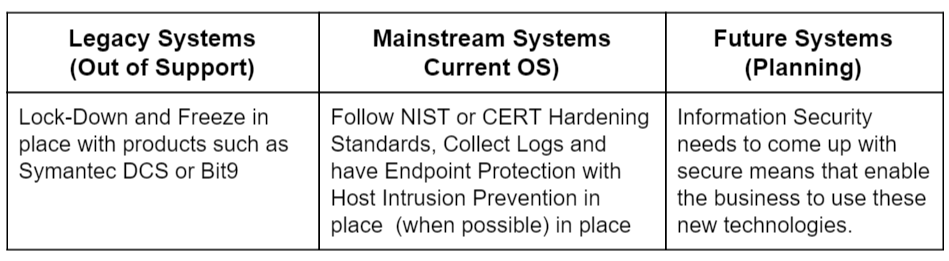
     Information Security professionals working in Critical Manufacturing should take the approach shown in Table 1 for dealing with the Computer Systems residing in the factory environment and that are on the plant floor.  By following this methodology the legacy systems will be protected while at the same time be able to continue doing the job they are good at and that they were purchased to do.  In most cases this approach will also reduce the overall risk that these systems pose to an acceptable level.

Legacy TableTable 1

This approach when combined with the network segmentation and smart firewall approach discussed in my previous blog on Critical Manufacturing is the start of a successful recipe in securing a Critical Manufacturing environment.

Information Security Defense in Depth Part 2 – A Bit More Technical View

Still for foundation level folks but a bit more technical view of Defense in Depth than last week’s post.