The Office of No, Really?

No  Successful ransomware attacks are at an all time high, we are losing the cyberwar, cyber criminals are making more money than ever before and it is only going to get worse, a cyber attack could be as damaging as a nuclear war – the headlines abound with comments such as this.   Yet, there are still a lot of postings about how information security should not be the office of No.   Really?  Information security is a security function,  as an information security professional are you really going to say – Yes, sure, go ahead and port that un-scanned software code into our production environment?  I would hope you are going to say no you cannot port that un-scanned software code into our production environment.  No is not a bad word, it is one that the job requires us to say.   If you are offended when someone says you are the office of No- don’t be.  To be a security professional no is a good response.  I train my team members to say “yes, but” in order to soften the perceived impression of the word no …..  (here’s a clue – “yes, but”  is still a no – no matter how you spin it).

However,  I have yet to sit in a business meeting and see any of my peers simply say no without being willing to engage in dialogue that would lead to a good and secure solution.   So for those who don’t like to say no then do it this way – yes you can put that server with 2 catastrophic exploitable vulnerabilities into the environment after we help you remediate the vulnerabilities or work on additional adequate controls that will allow us to use the server in a safe and secure manner.    For me, information security professionals can and should say no,  but after doing so we need to be helpful and smart enough to engage in conversations that help the business figure out how to do what they want to do in a way that is cost effective, safe and secure.

In many ways with the types and amount of successful attacks we are experiencing across the U.S. infrastructure being the office of Yes is a far more scary response than saying No to items that put your business at risk.

For Cyber Security the Perimeter Still Exists and Never Went Away


One item that really bugs me is to hear IT and Cyber Security professionals espouse that the perimeter is dead and that Cyber Security professionals should stop focusing on tools that protect the non-existing perimeter.   I was at a lunch with a fellow CISO a few months back and he had invited his CIO to lunch with us.   The CIO had recently attended a seminar where they talked about the perimeter no longer existing and he was truly wondering if he could just get rid of his firewalls.  It was a fun conversation but also a bit scary to me that the conversation actually had to take place.  The reality is that while the perimeter has changed we still host most of our systems and data in a data center or in multiple data centers and whether these data centers are on premise or in the cloud they still have a perimeter that needs protected.  Bad actors, both external and internal need to be kept out of areas they have no business being in.  To do that requires a strong perimeter consisting of next-generation firewalls such as the ones Palo Alto  or CISCO provides.  These first line perimeter defense tools should alert into your Security Alert tool (such as QRadar or Splunk) and should also be running Intrusion Prevention and WildFire type of technologies.

The Perimeter exists, heck in most organizations an argument could be made that multiple perimeters exist. Let’s quit saying that there is no Perimeter as the people we are tasked with protecting don’t need to be walking around thinking that they can get rid of their perimeter protection tools.

Why Protect End User Workstations Instead of Servers First?

I have been lucky enough to spend most of my Cyber Security career doing startup operations for large companies.  I thrive on the energy and passion that teams get when they are given the opportunity and support to design and implement security protections for their company.

One of the things that I am often asked is why do I focus some of my first efforts on locking down the end user system before locking down the servers and databases.  This is a great question and one that can spark many hours of debate.  Please don’t send me a lot of comments telling me that Databases and servers are where the information is – of course I know that.

For me, and remember my work has been mostly in very large global enterprises with a mix of blue collar and professional staff, it is a matter of evaluating risk.  In large companies it is often hard to know where all the servers are and who owns them but it is a pretty safe bet that the person running the server is a techie and has been running and protecting these types of systems for a number of years ergo they have much more knowledge of how to protect a system and how not to fall for a bad actors attack than most end users.   I need to consider whether 50,000 or 100,000 attack vectors (i.e. end user systems) , all with email accounts, usually with admin access to their systems and wanting to open attachments and PDFs pose more of a risk than 4-5,000 attack vectors (i.e. servers) that typically don’t surf the web or get email.   My choice in the first 12-18 months is to say that the end user systems pose more overall risk than the servers.  This leads to aggressively putting in controls and protections for those systems first.    Please don’t  take this out of context – of course in parallel I drive initiatives to patch server vulnerabilities, get servers logging into a Security Alerting system, setting up a SOC, etc.  but given choices with limited resources and time I choose to deploy end point encryption, good AV and HIPs, taking away admin rights, software such as Tanium, 2 factor authentication for email, etc. on the end user system first.


Critical Manufacturing Legacy Systems


     One common item that information Security Professionals working in Critical Manufacturing environments have to deal with is that of legacy systems. You see, in Critical Manufacturing environments it is very common for the systems that run and control factory lines to remain in place for a very long time. Some of these systems can be running Operating Systems(OS) that are 10 to 15 years out of date. In many cases these OS are no longer vendor supported and cannot be patched to remediate known exploitable vulnerabilities. These older systems are often used to run production lines and they still do a great job at doing what they were purchased to do.  It is difficult, rightly so, to convince the leadership team at a factory to spend money to replace something that is old but that is still doing the job it was purchased to do. It cost money and reduces potential profits to replace these old and outdated systems with new systems.  Because they continue to do the job they were purchased to do justifying the new spend can be a difficult thing to do.   

     From an Information Security point of view these systems pose a large risk to the overall manufacturing environment and if hacked could cause a large scale production outage.  In smaller companies this type of major Cyber attack can result in no longer being able to conduct business and permanently closing the doors.   Legacy systems that are commonly found on the shop floor are often 3, 4 or even 10 years out-of-date when it comes to standard Information Technology patching.  Information Security Professionals look at these systems as attack vectors while the people working in the Critical Manufacturing environment view them as cost effective work horses that are getting the job done. While cyber attacks on networks at Sony, Target, Home Depot and the US Government are getting all the press, the greatest cyber vulnerability is in manufacturing. “By raw numbers, and by the numerous manners of attacks, manufacturing is the most targeted area now, even compared to financial services,” Chet Namboodri, senior director of Global Private Sector Industries at Cisco, told Design News. “Financial services gets more press, but industrial networks get more attacks.” Attacks and warnings such as Stuxnet, Armaco, SolarWorld and U.S., Steel to U.S. regulators and security experts sending out an official warning that hackers could now access critical medical equipment including pacemakers and insulin pumps with potentially deadly results make the threat to Critical Manufacturing a real one.  Determining what to do in order to lock down and protect the Legacy systems while at the same time allowing them to continue doing the work they have been doing is a  major part of an Information Security professionals job.

     “You can’t scan that system (or you can’t put AV on that system) because it is old and fragile and if you bring it down we will not be able to produce our product”  Is way too common of a phrase in the Critical Manufacturing environment. In many cases Information Security Professionals are asked/told to please just leave the systems alone, do not run vulnerability scans, do not put antivirus on them, do not put a light firewall on them, do not patch them, do not put updates on them, etc.  This type of thinking by Information Technology and Factory leadership teams is shortsighted and is putting their entire production capability at huge risk of catastrophic failure.  As these legacy systems are outdated and no longer being supported by the vendor they are hugely exploitable to any blackhat or hacker that wants to take advantage of their exploitability. The reality is that the risk is real,  the risk is great and from past events we know that these systems pose easy to use attack vectors for blackhats, fraudsters and competitors seeking to cause negative business impact to the company.  

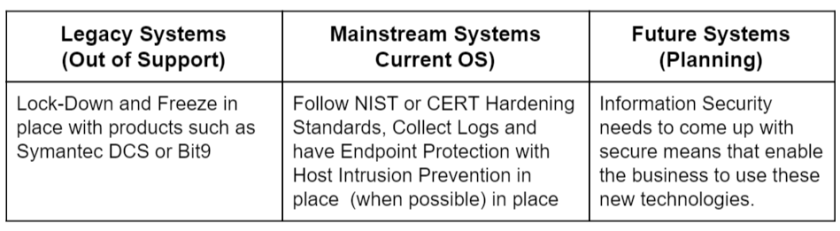
     Information Security professionals working in Critical Manufacturing should take the approach shown in Table 1 for dealing with the Computer Systems residing in the factory environment and that are on the plant floor.  By following this methodology the legacy systems will be protected while at the same time be able to continue doing the job they are good at and that they were purchased to do.  In most cases this approach will also reduce the overall risk that these systems pose to an acceptable level.

Legacy TableTable 1

This approach when combined with the network segmentation and smart firewall approach discussed in my previous blog on Critical Manufacturing is the start of a successful recipe in securing a Critical Manufacturing environment.

Information Security Defense in Depth Part 2 – A Bit More Technical View

Still for foundation level folks but a bit more technical view of Defense in Depth than last week’s post.


Critical Manufacturing Cyber Security Defense Program – A Starting Look

Cyber security professionals  are often tasked with trying to defend more than they have the resources to defend. This is especially true in the area of Critical Manufacturing as there tends to be a strong desire to protect everything.  In many cases when we try to protect everything we end up protecting nothing.  A Cyber Security Defense Program (CSDP) needs to be very focused and strategically deployed to protect the systems and areas which need protected.

Critical Manufacturing as defined by the Department of Homeland Security(DHS) is primary metal, machinery, medical, electrical and transportation.   Primary metal is Iron, Steel, Aluminum non-Feros metals;  medical includes facilities and devices, machinery is engines, turbines and power transmission, within electrical is electrical equipment manufacturing, transportation is :  vehicle, aviation and aerospace parts and vehicle manufacturing and railroad rolling stock.   Products made by these are essential to critical infrastructure sectors. The Critical Manufacturing sector focuses identification, assessment, prioritization and protection of nationally significant manufacturing industries within the given sector that may be susceptible to manmade or natural disasters.  This area is one that is critically in need of a strong CSDP.   The discipline for CSDP must not be twisted to taint what should be a strategic approach to the industrial base (“Critical Capabilities At Risk,” 2009).

One critical component to the protection of a Critical Manufacturing environment is that of using next generation, aka smart, firewalls with intrusion prevention and with some form  of malware  prevention and detection, updated via global feeds, enabled. This firewall environment should be set up in such a way as to segment the Critical Manufacturing infrastructure. Each individual plant or factory within the Critical Manufacturing environment should be on their own local area network (LAN) segment. A very basic way of thinking about this is captured in Figure 1 below.

Manufacturing Network Segmentation

Figure 1

Because of the method in which business decisions are made for factory systems it is critical that organizations involved in Critical Manufacturing use strongly firewalled network segmentation methods to ensure that each of their factory sites sit behind their own firewalls and on their own network segment (DHS, 2009).  This allows better control of the environment and enables the isolation of one factory without impacting the rest of the factories owned by the organization.  In this way if one factory is compromised by a hacker or group of hackers it can be removed and isolated from the organization’s global IT infrastructure.  Network segmentation, also called Network Control (NC) is a primary bastion for a defense in depth strategy and it can also be used to help prevent a blackhat from pivoting from a relatively unsecure factory system to a core business system.  Combining an Intrusion Prevention Appliance (IPS) or functionality with the firewall inside of a network segment provides a strong front line of perimeter defense for factories involved in Critical Manufacturing.  These IPS’ do not have to be overly tweaked and analyzed to be effective, running them in default signature mode is an adequate layer of defense for the network segment protecting and controlling a factory environment (DHS, 2009).

Cyber Security – A basic look at Defense in Depth

A basic somewhat quirky and fun look at Defense in Depth.


The Highest Risk Ever….. Not!


BlogWordleI just received one of my daily news reports about Cyber Security and it said something to the effect of such and such a Research group has found out that Application Security holes are at highest numbers ever and this number is expected to increase even further in 2016!  Companies really need to focus on fixing the risk incurred by these applications.  I thought, “Wow, Really”?  I mean yet another highest number, highest risk, most vulnerable, more danger than ever before message.  What a surprise it was to get yet another news feed about a Cyber Security vulnerability being the worst ever.  (that last sentence is dripping with sarcasm – just in case you couldn’t tell).   I really just want to shout and scream out that No It Isn’t the highest total ever!  None of these items being touted as worst ever are really the worst ever.  The simple reality is that we are still in our relative infancy when it comes to Cyber Security as a profession and as something to write about.  Being in our infancy means that we are still finding lots of this things that we couldn’t find before.

None of these vulnerabilities appeared overnight.  The vulnerabilities that we are now finding and that are generating these, at times horrific, Blog- Overnightreports about numbers of vulnerabilities have always been there.  Not only have these vulnerabilities been there but here is a secret I will let you in on – there are many more that we still haven’t discovered!  Companies, researchers, etc. now have the proper tools to discover concerning Cyber Security  vulnerabilities in large numbers.  These are items that in the past no one knew about even though they were there.  As more and better tools come out we will find even more of the worst vulnerabilities ever.

Vulnerable OS, vulnerable Webpages, vulnerable coding, vulnerable hardware or firmware,  these items have been around for decades and will remain around.  So while it is great that we can now find these and do something about fixing and remediation of these vulnerabilities they aren’t new.  Maybe newly discovered or newly recognized but they have always been there.   

Why am I going on about something that is basically hype, and in some ways good in that it publicizes exposure to these items so that Cyber Security professionals can use them to raise awareness, funding and support for remediation?  Because of the way the reports and news articles are written.  In too many cases these articles raise awareness and hype of issues that are much lower risk than the ones the organization’s Information Security team are already working on.  I have sat in many meetings where executive management has looked at the Chief Information Security Officer (CISO) and said “I know your team is really busy remediating core vulnerabilities across our Financial landscape but I read something yesterday about mobile devices being very vulnerable and I think we need to re-focus our resources….  the article really made this mobile risk sound like the most dangerous thing ever.”  

Don’t get me wrong,  I appreciate the awareness being generated but …. the WORST EVER …. no in most cases it really isn’t.  There are lots of Cyber Security items just as bad or worse that most organizations need to fix and the decision on where the highest Information Security risk sits inside of the company should not be decided by reporters and vendors but should rest on the shoulders of the CISO and the experts they have hired to analyze and determine what risk items need immediate attention.


A Note I Wrote to Someone Who Once Worked for Me

I recently had the honor to help provide a strong reference for a person who worked for me as a Cyber Analyst.  She got the Senior position she was going for but was just a little worried about what they should do in order to lead a team and be a good leader.  Here is what I related to this extremely competent future Cybersecurity leader.

Hi:

First and foremost – you are going to do great in your new role. I encourage you to model your leadership style after the following rule(s):

Use the leadership model of:
Am I doing the right thing
Am I doing it for the right reason
Am I doing it at the right time
Am I doing it in the right way

This is on the back of the Challenge Coin I had made up for our UC team.

Always act with Integrity and walk your talk. You don’t always need to be right but you always need to be honest with the people you lead.

Remember that “We are smarter than Me” and foster healthy discussion and debate on topics. Try to pull ideas and suggestions from those you lead who are more on the quiet side. Don’t let aggressive Type A personalities (like me) dominate the conversation.

When coming out of a meeting get your team members used to doing a 5 minute feedback session (what did we do right, wrong, what should we (or I) have done differently, etc. Remember – Feedback is a gift.

Training of your people needs to be a priority and always remember to help others be Greater Than Yourself. There is enough success out there for everyone, help grow your people so that they can be your boss some day and if that did happen they would be a good boss to work for.

Don’t hesitate to email if you have specific questions. Have confidence, breath deep and believe in yourself – you got this!

Your Horse Was Analog

Your Horse Was Analog

Kevin L. McLaughlin

A  speech I made to 350+ people at the Michigan joint Military Ball.  Amway Grand Plaza Hotel.

Like my tie? My wife didn’t – gave me a lot of grief before we left the house,  you know how difficult things can be when your significant other doesn’t approve of your choice in clothing.

Well you see this tie has snoopy, the moon, the space shuttle and Apollo craft on it and it was given to me by Fred Hayes, yes the Apollo 13 Fred Hayes , yes astronauts are pretty neat people,  anyways Fred gave this to me when we were working on a project together and he told me that whenever I wore this tie I could look down at the pictures and that no matter what I do in the life I should remember that if we put a man on the moon we can do anything as a country.

…. as a country we can do anything,  even figure out how to defeat this cyber threat.

I want to change that thought just a little bit because I know what type of people went to and walked on the moon –  as a whole the U.S. Military and its veterans can do anything   make no mistake we are under attack, not by conventional weapon systems like guns and missiles but by cyber warriors utilizing digital attack vectors.

My speech tonight will be about trust and how it will help us win our cyber battle.  But, before I start I would like to do a shameless plug for the Whirlpool Veterans Association, who mentors soldiers transitioning to the private sector and with multiple outreach programs – I am sure many of the companies you work for have similar programs and a big thank you to those as well.

Trust and authority will be tonight’s theme. A lot of Information Security Professionals left Home Depot after years of not having their voices heard and repeatedly being over-ridden about whether a system could be touched or not.  Many Board of Directors are asking how to fix the cyber issue  –  a lot of the CIO’s and some of the CISO’s when asked that question are taking a passive posture of saying that their job is to make them aware of the risk versus telling them what to do.  In my opinion that is not the right answer… the people who are trained in cyber defense need to drive answers and solutions not just show risks

I will admit though that this morning while I was working out I had a big moment of angst,  you see I am an expert in this field and I can have an opinion and if I get it wrong a company will lose money but you know – if you get it wrong  lives will be lost and in the worst case our Homeland can fall.  Even with that – tonight you will hear what I feel we need to do in order to start winning the cyber battle.  We got our butts kicked by the bad guys in 2014 and it was a loud wake up call to anyone paying attention that what we have been doing is not the answer.

The general theme throughout my speech tonight will be one of trust. High performing teams consist of players that trust each other and who understand that each of the team members has an area that they are the expert in.  We cannot continue to ignore or muffle the voices of our highly trained and skilled cyber defenders and expect to be successful in our cyber defense efforts.

One of the first things we need to understand is that there is always in existance a large understanding gap.  I got my first taste of this type of understanding gap when I returned from Basic Training and I was talking to my Grandpa.  He asked me where I was stationed and I said Fort Bliss Texas,  he asked me what units were stationed there and I said the 3rd Cavalry. He got excited and we started talking;  about 5 minutes into the conversation it dawned on me that he was talking horses and I was talking tanks.  He was talking analog.

You see, we continue to increase our combat effectiveness by implementing new tools and technologies the majority of which are not analog, but are instead digital.  Digital means that they present entirely different attack vectors and will require us to have an entirely different level of trust in the expertise of the cyber defenders we put in place.  We must protect our digital assets.

The current generation of service men and woman are some of the first who have known nothing but digital tools.

(I left out this next part due to time constraints)

[Did anyone see the movie BattleShip? It’s a bit of a cheesy movie but there is a part in it where the modern digital destroyer gets blown up and the only available ship to fight the aliens was a WW II BattleShip,  they are working to try and figure out how to use the ship and the Chief looks at the Ensign and says “sir, this old thing is completely analog, it will take us years of reading the manuals to learn how to float and fight it”.  All of a sudden a long line of navy veterans come walking up and they are able to work side by side to show the team how to run and fight the ship –  think about this – in another 10 to 15 years people who understand analog are not going to be around to help us out.  ]

I continued my speech here —    I have to wonder how many of these digital troops would use a smartphone or GPS, even if disallowed in the mission parameters,  if they get lost during training?  I’m not disparaging anyone, I just realize how very hard it would be for any level of team leader to stop themselves from using an alternative before calling into command and telling someone that they were lost.  We all know how difficult that radio call would be to make.

What is scary is that if these digital devices were suddenly taken away our combat effectiveness would be greatly impacted – maybe by 90% or greater.  Ok,  each of your digital devices, smartphones, etc. have just been reset to 0:00 – how many of you can tell me what time it is?  Show of hands  {note – out of 350+ people in attendance only 2-3 raised their hands} wow, that was actually far worse than I expected it was going to be.

Having these digital items give us a significant advantage but also put us at risk if we don’t adequately protect them from cyber attack.  Tanks, Planes and ships will not operate if their computer systems are taken off-line.  Year after year we see annual reports that tell us  that our military systems are in no better shape than private sector systems are and our military IT staff feels the same pressures to get systems in place quickly rather than securely – we must be better than that. {looked down at tie and lifted it up}  We can do anything….

Most of us Cybersecurity professionals (risk professionals, assurance, etc. ) are very passionate about what we do – I personally spend upwards of 30-40 extra hours each week staying current, learning, wargaming, gathering intelligence, figuring out business enabling security strategies, and more.

How many of you in this room (Cybersecurity men and women you are not allowed to answer) can say you spend that much time studying and focusing on cybersecurity? How many of you even spend 2 hours per week?  Of course you don’t spend time studying Cybersecurity nor should you – that’s why you put cyber security professionals on your team.

Then why is it that across Corporate America, and I can only imagine it is a bit worse in the military, is it so hard to build trust between the Cyber defenders and the management community of the organization?  I know some of you are sitting out there thinking -What’s this guy talking about – I trust my Cybersecurity person.  Do you?  Do you really?

Think about this … you are the Colonel in charge of finance imagine an E6 Cyber defender walking into your office at month end closure and telling you that he has to take one of your business critical system off-line immediately for security patching as it is critically exposed and can be very easily compromised which could put the rest of our infrastructure at risk. He then tells you that the outage may last 8 to 10 hours.    Well, after 17 years experience as a security professional in Corporate America I can tell you that this request would be met with a lot of resistance and most likely the Cyber Defender will be told to wait for a day or two to do the patching.   Often times that directive will come with a comment about “you security guys and girls don’t really understand the business and tend to over-react”….

Hmmm…  I can only imagine similar conversations happening inside of Target, HomeDepot, Sony, Subway, Dairy Queen, Sigh, I’m not going to name them all – but like I said earlier we really got our butts kicked in 2014.  2015 continues the theme with the Anthem breach – a breach which directly impacts each one of you the Feds feel China committed the breach to continue their mission of gathering the personal data of our active and former military and their dependents.  We don’t know what they want the data for but it is obvious that they want it

Trust,  Target has a 148 million reasons – those are dollars by the way – plus open lawsuits, HomeDepot has 120 million reasons and Sony has 1 billion reasons, to implement a Cyber Defender authority policy.   1 billion?  how many of you work for companies that would even be able to survive a 1 billion dollar loss? I imagine if I lost a billion dollars for a company I’d be out on the street. and luckily for us we are starting to see Board Chairman, CEOs and CIOs resigning due to allowing a security breach to occur on their watch. Why is that lucky?  because it might raise the awareness we need to help fix this issue.

A base level of trust needs to be in place that makes it so that is assumed your cyber defender, who also is part of your profit sharing plan and wants the company to make money or who is a strong patriot and wants our tanks to run or planes to fly,  is not going to willy-nilly.  I just wanted to say willy-nilly in a formal speech,  is not going to willy-nilly take systems off-line and that when they say a system really needs to be fixed immediately they need to be granted the authority, we already give them the responsibility and career risk when a breach occurs,  now let’s give them the authority they need to protect the organization,  even if there is a small short term negative profit impact – wow that is hard to say but I bet if we asked Target, HomeDepot, Sony, Anthem, you get the idea if they could go back in time and accept a $5,000.00 profit hit in order to take a system off-line and patch it instead the breach they would all say yes.

For you the risk of allowing the E7, E8, Lt. Captain, Major, etcetera, I’d try to go on but I’ve been out of the military for a loooong time and would most likely get the other command ranks wrong…   to trump the cyber defender may just result in a significant loss to both your combat effectiveness and your ability to defend our country.

Trust,  trust the cyber defense experts that we are graduating from our military schools to both understand the business and to effectively assess the risk and make the call on fixing open and exploitable channels of attack.  While the department heads and commanders should still have the final say an answer of “don’t touch this system” or an answer of “you are over-reacting to this threat  – yet how would they even have the expertise to make that judgment?  should be the rare exception and not the norm.       – Trust and authority-   we can win this cyber war and defend our systems against the cyber threat.