
SECURING CORPORATE IoT DEVICES: CHALLENGES, STRATEGIES, AND THE ROLE OF AI AND ML IN CYBERSECURITY

The rapid proliferation of IoT devices within corporate infrastructures has left organizations more vulnerable than ever to cyberattacks. It is essential to adopt a comprehensive approach that incorporates various techniques, tools, and emerging technologies, such as AI and ML, to effectively defend against these evolving threats. – Dr. Kevin Lynn McLaughlin, PhD 

As the Internet of Things (IoT) continues to grow and proliferate, it is increasingly clear that IoT devices pose a significant cybersecurity risk to organizations. (Fazel et al., 2022) One of the primary challenges it poses is that it can be difficult to obtain relevant cybersecurity alert data from these devices into a corporate Security Information and Event Management (SIEM) system. As a result, cyberattacks that target IoT devices are often not detected by corporate cybersecurity Security Operations Centers (SOCs) in time for an effective response to be launched early in the attackers’ kill chain. Many IoT devices lack the ability to generate cybersecurity alert data in a format that can be easily consumed by a SIEM. For example, some IoT devices may only provide basic telemetry data that does not include information about cybersecurity events, making it difficult to distinguish normal behavior from malicious activity or abnormal behavior. In addition, many IoT devices are designed to operate independently and may not be able to communicate with a central monitoring system, making it difficult to detect anomalies and respond to threats in real-time.  

To address the multifaceted challenges posed by the integration of IoT devices within corporate infrastructures, it is imperative for organizations to adopt a diverse array of techniques, processes, and cybersecurity tools. These measures are designed to prevent, monitor, and detect any abnormal behavior exhibited by the IoT devices operating within their networks. A fundamental technique to consider is the implementation of network segmentation, which necessitates the division of the overarching corporate network into smaller, more manageable subnetworks. This approach effectively limits the potential impact resulting from a compromised IoT device, simultaneously impeding the ability of attackers to move laterally within the network and diminishing the risk of data exfiltration. Furthermore, organizations should prioritize the implementation of security controls at the device level. This can encompass a variety of measures, including the deactivation of unused services and ports, the diligent updating of firmware and software, and the careful configuration of access controls to restrict device access to authorized personnel only. Additionally, organizations can leverage network access control (NAC) technologies as a means of enforcing stringent policies regarding the types of devices permitted to connect to the corporate network, as well as the levels of access granted to each. By adopting this comprehensive strategy, organizations can significantly reduce the likelihood of unauthorized devices appearing in various locations, such as conference rooms, break rooms, and employee offices, which might otherwise be connected to the corporate infrastructure without proper oversight. In doing so, organizations will be better equipped to safeguard their networks and valuable data from the ever-evolving threats targeting IoT devices. 

In the pursuit of effectively monitoring and detecting IoT devices within an organization’s network, it is crucial to harness the power of the corporate cybersecurity Security Orchestration, Automation, and Response (SOAR) team. By leveraging the expertise of these professionals, organizations can design and implement strategies and solutions tailored to detecting abnormal behaviors originating from IoT devices, ultimately strengthening their cybersecurity posture.  A plethora of cybersecurity tools are available to aid organizations in monitoring and detecting IoT devices, encompassing IoT device discovery and inventory tools, network traffic analysis tools, and endpoint detection and response (EDR) tools. When used effectively, these tools enable organizations to pinpoint IoT devices on the network, scrutinize network traffic for any suspicious activity, and identify as well as respond to security incidents in real-time. The SOAR team in conjunction with your Cybersecurity Architects and Cybersecurity integration engineers can play a crucial role in optimizing the deployment and configuration of these tools, ensuring that they work in concert to provide comprehensive visibility and protection against threats targeting IoT devices. 

Artificial intelligence (AI), machine learning (ML) and blockchain technologies (Yu, 2018) (Dey, 2021) are also becoming increasingly indispensable in the defense of corporate IoT devices. These innovative technologies can augment the capabilities of the SOAR team by providing advanced analytics and automation. For instance, ML algorithms can be utilized to analyze network traffic, detecting anomalies that could potentially signify a cybersecurity threat. By incorporating these technologies into the organization’s cybersecurity strategy, the SOAR team can more effectively identify and prioritize potential threats, empowering them to focus their efforts on the most pressing concerns. In addition to bolstering threat detection, monitoring, detection and alerting AI can be harnessed to automate incident response processes, allowing organizations to react more swiftly and efficiently in the face of an attack. The SOAR team can take advantage of AI-driven automation to streamline workflows, reduce response times, and minimize the impact of security incidents on the organization’s operations and reputation. The corporate cybersecurity SOAR team plays a pivotal role in the creation and implementation of strategies aimed at detecting abnormal behaviors originating from IoT devices. By leveraging a diverse array of cybersecurity tools, as well as incorporating AI and ML technologies into their arsenal, the SOAR team can significantly enhance an organization’s ability to identify, monitor, and respond to the growing array of threats targeting IoT devices within their corporate infrastructure. 

In conclusion, the proliferation of IoT devices within corporate environments presents an array of complex cybersecurity challenges, rendering organizations increasingly vulnerable to cyberattacks. To counteract these evolving threats, a comprehensive approach is necessary (S. Forsström, 2018), incorporating a diverse range of techniques, processes, and cybersecurity tools, as well as harnessing the power of emerging technologies such as AI and ML. By leveraging the expertise of the corporate cybersecurity SOAR team, Cybersecurity Architects, and Cybersecurity Integration Engineers, organizations can develop and implement tailored strategies to effectively monitor, detect, and respond to abnormal behaviors originating from IoT devices. This collaborative and multifaceted approach is crucial in safeguarding corporate networks and valuable data from the ever-growing threats targeting IoT devices. As I stated at the start of this article, “It is essential to adopt a comprehensive approach that incorporates various techniques, tools, and emerging technologies, such as AI and ML, to effectively defend against these evolving threats.”(Zaman, 2021) By embracing this holistic strategy, organizations can significantly enhance their cybersecurity posture, mitigating the risks associated with the integration of IoT devices within their corporate infrastructures. 

References: 

Dey, A., Jara, A.J., Al-Jaroodi, J. (2021). Blockchain-based security and privacy in Internet of Things: A survey. Journal of Network and Computer Applications, 173. https://doi.org/https://doi.org/10.1016/j.jnca.2021.102837  

Fazel, E., Shayan, A., & Mahmoudi Maymand, M. (2022). Designing a model for the usability of fog computing on the internet of things. Journal of Ambient Intelligence and Humanized Computing. https://doi.org/10.1007/s12652-021-03501-5  

S. Forsström, I. B., M. Eldefrawy, U. Jennehag and M. Gidlund. (2018). Challenges of Securing the Industrial Internet of Things Value Chain Workshop on Metrology for Industry 4.0 and IoT, Brescia Italy.  

Yu, Y. (2018). Blockchain-Based Solutions to Security and Privacy Issues in the Internet of Things. IEEE Wireless Communications, 25(6), 12-18. https://doi.org/doi: 10.1109/MWC.2017.1800116  

Zaman, S. (2021). Security Threats and Artificial Intelligence Based Countermeasures for Internet of Things Networks: A Comprehensive Survey. IEEE Access, 9, 94668-94690. https://doi.org/doi: 10.1109/ACCESS.2021.3089681  

ORCID – https://orcid.org/0009-0009-8367-5292

EDPACS _ 2023 _ Kevin Lynn McLaughlin, PhD  & Erik S. A. Elliott

EDPACS _ 2023 _ Kevin Lynn McLaughlin, PhD  & Erik S. A. Elliott

Unleashing the Power of Mobile Threat Hunting Toolkits: Why They Are Crucial in Today’s Cybersecurity Landscape

“Mobile threat hunting toolkits are a crucial component of modern cybersecurity strategies, providing greater efficiency, accuracy, & agility in detecting and mitigating threats.”- Kevin Lynn McLaughlin, PhD

In today’s highly connected world, the cybersecurity landscape has become increasingly complex and challenging, requiring organizations to implement strong and adaptable cybersecurity measures to protect their digital assets and data. The development of advanced technologies, such as artificial intelligence (AI) and machine learning (ML), along with the rise of quantum computing, has made the job of cyber defenders more difficult and complicated. One important strategy for strengthening an organization’s cybersecurity is to deploy specialized teams focused on threat hunting. These skilled professionals, who have extensive knowledge of cybersecurity, work diligently to examine the organization’s infrastructure every day, determining whether any adversaries have breached their systems.(Hermawan, et al, 2021)

The strategic execution of threat hunting responsibilities is facilitated by the utilization of sophisticated threat hunting toolkits, designed to meticulously unearth the presence of bad actors lurking within the organization’s environment. These toolkits empower threat hunting teams to detect abnormal activities early in the cyber kill chain, enabling them to take swift and decisive action to neutralize the impending threat before it can cause harm to the organization. An assortment of diverse threat hunting toolkits is available to assist these teams in their pursuit of cyber adversaries. Each toolkit boasts unique features and capabilities, tailored to identify, and mitigate a variety of cyber threats, and fortify the organization’s defenses against the ever-looming specter of cyber-attacks. These toolkits serve as essential instruments in the hands of adept threat hunters, who wield them with dexterity and finesse to safeguard the organization’s digital landscape, and in so doing, contribute significantly to the preservation of the organization’s integrity and security in this rapidly evolving digital age. (Warner & Johnson, 2016)

Companies such as Gartner, a leading research and advisory firm, recognize the importance of threat hunting toolkits in today’s cybersecurity landscape. According to Gartner, threat hunting toolkits are essential for organizations seeking to proactively detect and respond to potential security threats. Research indicates that the best threat hunting toolkits offer a comprehensive suite of tools for threat detection, investigation, and response and can integrate with a variety of security technologies and data sources. As cybersecurity threats become increasingly complex and sophisticated, organizations must rely on advanced tools and technologies to detect and respond to potential breaches. One of the most promising developments in this field is the use of machine learning algorithms and other forms of automation in threat hunting. By automating the process of threat detection and analysis, organizations can improve the efficiency and accuracy of their cybersecurity efforts. This is particularly important in today’s fast-paced threat landscape, where malicious actors can strike quickly and with devastating consequences. Automation in threat hunting also allows security teams to focus their attention on the most critical threats, minimizing the risk of human error and ensuring that potential breaches are addressed in a timely manner. By using advanced analytics and risk assessment techniques, threat hunting toolkits can provide security teams with a clear understanding of the severity of a given threat and its potential impact on the organization. The importance of automation in threat hunting cannot be overstated. In today’s rapidly evolving threat landscape, cybersecurity teams need to stay ahead of malicious actors to protect their organizations from security breaches. To achieve this, organizations must harness the power of machine learning algorithms and other advanced technologies to proactively detect and mitigate potential threats. (Aldauiji, F., et al, 2021) Leveraging these technologies alone may not be enough. To truly stay ahead of the curve, organizations should also consider integrating cybersecurity SOAR (Security Orchestration, Automation and Response) technologies into their threat hunting and incident response efforts. By integrating SOAR technologies with threat hunting toolkits, organizations can automate the threat hunting process. This reduces response times and minimizes the risk of human error, enabling cybersecurity teams to quickly and effectively respond to security incidents. Cybersecurity SOAR technologies can help organizations establish a standardized incident response framework, allowing for greater consistency and efficiency in incident response efforts. This is particularly important for organizations managing many cybersecurity incidents or having limited resources to dedicate to incident response. While leveraging machine learning algorithms and other advanced technologies is crucial for proactive threat detection, organizations should also consider the benefits of integrating cybersecurity SOAR technologies into their threat hunting toolkit strategies. By doing so, they can streamline their processes, reduce response times, and ensure the ongoing detection of bad actors in their infrastructure.

In the realm of organizational cybersecurity, a particularly intriguing and advantageous option presents itself in the form of the Portable Analysis and Network Threat Hunting and Evaluation Resource, more commonly referred to as the PANTHER. The PANTHER embodies a portable toolkit for threat hunting teams, honing its focus on three pivotal areas that serve as the crux of a threat hunter’s value to an organization’s security posture—areas which have, until now, frequently been the source of stumbling blocks within the security landscape. PANTHER offers a swiftly deployable package, reminiscent of a fly-away kit, that boasts versatility in deployment across a multitude of scenarios. These scenarios encompass not only incident response, but also heightened visibility and security in network segments that are non-compliant due to disparities in technology, an absence of controls, or even during the often-complex Merger and Acquisition (M&A (Mergers & Acquisitions)) process. Additionally, these toolkits can be uniquely tailored to suit non-traditional enterprise systems, such as Operational Technology (OT), Industrial Control Systems (ICS), or other non-IP based communication systems. In the past, enterprise responses have frequently been mired in bureaucratic red tape, processes, and approvals. However, the rapid deployment capability of these kits, which operate outside of the standard “gold image” tools, allows for a significantly reduced response time and a broader range of response locations, unhindered by pre-existing IT (Information Technology) infrastructure constraints. Moreover, the ever-evolving landscape of Advanced Persistent Threats (APTs) and other highly sophisticated actors, who are relentlessly leveraging their resources, skills, and artificial intelligence to bypass security measures, poses an ongoing challenge. During the reconnaissance phase, an organization’s profile, as delineated by its security tools and programs, becomes exposed and subsequently targeted for evasion. The PANTHER toolkit counters this by being deliberately constructed with an alternative compilation of tools, designed to facilitate advanced visualizations, in-depth analysis, and adaptability in data representation. This allows for the detection of even the most intricate behavioral patterns. Mainly employing a passive implementation model, these toolkits are deployed with existing Incident Response (IR) processes or enterprise solutions to undertake actions as required. This approach affords threat hunters the dual advantage of remaining undetected during on-network reconnaissance, while simultaneously gaining a profound internal perspective of the network in question. Although it is unrealistic for any organization to supply every conceivable log and data point a threat hunter might desire, the PANTHER toolkit’s deployment model enables it to be situated in highly sensitive “crown jewel” locations, subsequently amassing a wealth of logs. This, in turn, facilitates a good economic solution that provides high-fidelity protection of an organization’s most precious assets, further cementing the toolkit’s invaluable contribution to the security posture. (Bohme & Schwartz,2016)

There are a lot of great vendor partners that play in the threat hunting space. Gartner’s “Market Guide for Threat Hunting” (Gartner, 2020) provides a detailed overview of the threat hunting toolkit landscape, highlighting key vendors and their respective capabilities. Some, just a small amount from the list, of the vendors mentioned in the report include Elastic, Exabeam, FireEye, Crowdstrike and Splunk. Overall, Gartner’s position on threat hunting toolkits aligns with the view that these tools are crucial for organizations seeking to stay ahead of the evolving threat landscape. By leveraging the capabilities of threat hunting toolkits, security teams can gain greater visibility into potential threats and proactively respond to them, mitigating the impact of security breaches and reducing the risk of data loss. (V. S. Sree, et al 2021)

As the digital world continues to grow and presents new challenges, organizations must adapt and strengthen their cybersecurity measures to protect their assets and data. The integration of advanced technologies like AI, ML, and quantum computing has made cyber defense more complex, and specialized threat hunting teams have become vital to maintaining cybersecurity. (Bhardwaj & Goundar,2019) These teams rely on sophisticated threat hunting toolkits to identify and neutralize threats early in the cyber kill chain. A variety of toolkits are available to suit diverse needs and capabilities, allowing organizations to better defend against cyber-attacks. Automation and machine learning algorithms are critical developments in this field, improving the efficiency and accuracy of cybersecurity efforts. Industry leaders like Gartner emphasize the importance of threat hunting toolkits and the benefits of integrating cybersecurity SOAR technologies into threat hunting strategies. This integration allows organizations to automate their processes, reduce response times, and continuously detect threats within their infrastructure. Options such as PANTHER, a portable threat hunting toolkit, can provide valuable resources for threat hunting teams. Gartner’s “Market Guide for Threat Hunting” highlights key vendors in the space, such as Elastic, Exabeam, FireEye, Crowdstrike, and Splunk, demonstrating the critical role of these toolkits in staying ahead of the evolving threat landscape. Organizations must adopt a proactive approach by leveraging advanced tools, technologies, and strategies to protect their digital landscape and ensure ongoing cybersecurity in this rapidly changing digital age.

References

Bhardwaj, A., & Goundar, S. (2019). A framework for effective threat hunting. Network Security, 2019(6), 15-19.

Böhme, R., & Schwartz, G. (2016). Modeling Cybersecurity Investment in Attack and Defense. In 2016 15th IEEE International Conference on Trust, Security and Privacy in Computing and Communications (TrustCom) (pp. 372-379). IEEE. https://doi.org/10.1109/TrustCom.2016.0083

Hermawan, D., Novianto, N. G., & Octavianto, D. (2021). Development of Open Source-based Threat Hunting Platform. Paper presented at the 2nd International Conference on Artificial Intelligence and Data Sciences (AiDAS), downloaded on April 19, 2023.

Gartner. (2020). Market Guide for Threat Hunting Toolkits. Gartner, Inc. Retrieved from https://www.gartner.com/en/documents/3993665/market-guide-for-threat-hunting-toolkits

N Aldauiji, F., Batarfi, O., & Bayousef, M. (2021). Utilizing Cyber Threat Hunting Techniques to Find Ransomware Attacks: A Survey of the State of the Art. IEEE Access. doi: 10.1109/ACCESS.2021.3064371

V. S. Sree, C. S. Koganti, S. K. Kalyana and P. Anudeep, “Artificial Intelligence Based Predictive Threat Hunting In The Field of Cyber Security,” 2021 2nd Global Conference for Advancement in Technology (GCAT), Bangalore, India, 2021, pp. 1-6, doi: 10.1109/GCAT52182.2021.9587507.

Warner, J., & Johnson, R. (2016). Leveraging Threat Hunting Techniques for Improved Cybersecurity. In 2016 IEEE 2nd International Conference on Cyber Security and Cloud Computing (CSCloud) (pp. 164-169). IEEE. https://doi.org/10.1109/CSCloud.2016.32

https://orcid.org/0009-0009-8367-5292

Retaining Cybersecurity Talent

.    

Kevin M’s Tips For Retaining Top Cybersecurity Talent

As the cybersecurity threat landscape continues to evolve, it’s important to have a talented and skilled team in place to protect your organization’s assets and data. However, finding and retaining cybersecurity talent can be a challenge.

The following best practices can help ensure your top performers stay with your organization for the long term:

  • Provide competitive compensation and benefits packages

This includes not only salaries and bonuses, but also benefits like healthcare, retirement plans and paid time off. 

  • Create a supportive and inclusive work environment. 

This can be done by ensuring your team members feel valued and respected. They should be able to see a clear path for professional growth and advancement within the organization. This can be achieved through regular performance evaluation, opportunities for skills development and recognition for a job well done.

  • Offer flexible work arrangements 

This includes hybrid, remote work, and onsite options as well as flexible schedules to meet the needs of your team – which is especially important post-covid.

  • Develop a strong company culture 

This can be done by encouraging open communication, promoting teamwork and collaboration, and fostering a sense of community amongst your team members. This not only helps to create a positive work environment, but it also helps to build strong relationships and a sense of belonging across the team. 

  • Invest in your team’s professional development 

This can be done through a comprehensive and continuous learning program that offers opportunities for your team members to expand their skills, learn about modern technologies and stay up-to-date with the latest industry trends.  Offering a combination of in-person training sessions, online courses, and hands-on experiences with innovative technologies is a great way to implement this program. Providing your team with the resources and support they need to grow and develop professionally can increase job satisfaction and help foster a sense of pride and ownership within your organization. 

Threat actors are working diligently every day to find new ways to compromise sensitive data and assets. Therefore, it is essential to have a strong cybersecurity team in place to protect your organization. Prioritizing the above best-practices is a great way to keep your team members engaged and motivated, which will increase the likelihood of retaining your top cybersecurity talent for the long-term.    

Thank you to my friend and colleague Ibn Akbar at Nice Touch Editing Services for helping me with the edits for this entry.

Small and Medium Size Organizations at Risk

The bad guys are now starting to target mid-tier companies with their hacking activities.  In many cases these companies have not yet come to realize that having a Certified Chief Information Security Officer (C|CISO) or a Virtual Cerified|CISO (vC|CISO) is something that needs to be accepted as a part of doing business.  The recent Presidential report on how Cyber Attacks impact the economy of the U.S.A. makes it clear that the cost of having a security expert on staff or on retainer is well worth it if the smaller company wants to remain in business.  Cyber crime is putting many of these smaller companies out of business simply because they cannot recover from the post breach losses.   At the same time these companies may not have the dollars to pay for a full time C|CISO, so their alternative is to explore the vC|CISO concept.  The vC|CISO model can be leveraged to effectively manage security risk for small to mid-tier companies.

If a company is going to explore the hiring of a vC|CISO they need to make sure to do their due diligence and ask about the certifications (such as the one in the graphic below) and experience of the vC|CISO they are going to have giving them advice.  While there are a lot of good vC|CISO options available there are just as many vendors and security professionals touting themselves as vCISO’s who lack the background or experience to be of much help.  I lack quantifiable data on this point but I would say you should expect to pay between 3 and 400.00 per hour for a vC|CISO, the good news is you can choose what % of their time you want them to work for you (10%, 20%, on retainer, etc.) and then only pay for that portion of time.

Certified CISO

The Office of No, Really?

No  Successful ransomware attacks are at an all time high, we are losing the cyberwar, cyber criminals are making more money than ever before and it is only going to get worse, a cyber attack could be as damaging as a nuclear war – the headlines abound with comments such as this.   Yet, there are still a lot of postings about how information security should not be the office of No.   Really?  Information security is a security function,  as an information security professional are you really going to say – Yes, sure, go ahead and port that un-scanned software code into our production environment?  I would hope you are going to say no you cannot port that un-scanned software code into our production environment.  No is not a bad word, it is one that the job requires us to say.   If you are offended when someone says you are the office of No- don’t be.  To be a security professional no is a good response.  I train my team members to say “yes, but” in order to soften the perceived impression of the word no …..  (here’s a clue – “yes, but”  is still a no – no matter how you spin it).

However,  I have yet to sit in a business meeting and see any of my peers simply say no without being willing to engage in dialogue that would lead to a good and secure solution.   So for those who don’t like to say no then do it this way – yes you can put that server with 2 catastrophic exploitable vulnerabilities into the environment after we help you remediate the vulnerabilities or work on additional adequate controls that will allow us to use the server in a safe and secure manner.    For me, information security professionals can and should say no,  but after doing so we need to be helpful and smart enough to engage in conversations that help the business figure out how to do what they want to do in a way that is cost effective, safe and secure.

In many ways with the types and amount of successful attacks we are experiencing across the U.S. infrastructure being the office of Yes is a far more scary response than saying No to items that put your business at risk.

For Cyber Security the Perimeter Still Exists and Never Went Away


One item that really bugs me is to hear IT and Cyber Security professionals espouse that the perimeter is dead and that Cyber Security professionals should stop focusing on tools that protect the non-existing perimeter.   I was at a lunch with a fellow CISO a few months back and he had invited his CIO to lunch with us.   The CIO had recently attended a seminar where they talked about the perimeter no longer existing and he was truly wondering if he could just get rid of his firewalls.  It was a fun conversation but also a bit scary to me that the conversation actually had to take place.  The reality is that while the perimeter has changed we still host most of our systems and data in a data center or in multiple data centers and whether these data centers are on premise or in the cloud they still have a perimeter that needs protected.  Bad actors, both external and internal need to be kept out of areas they have no business being in.  To do that requires a strong perimeter consisting of next-generation firewalls such as the ones Palo Alto  or CISCO provides.  These first line perimeter defense tools should alert into your Security Alert tool (such as QRadar or Splunk) and should also be running Intrusion Prevention and WildFire type of technologies.

The Perimeter exists, heck in most organizations an argument could be made that multiple perimeters exist. Let’s quit saying that there is no Perimeter as the people we are tasked with protecting don’t need to be walking around thinking that they can get rid of their perimeter protection tools.

Why Protect End User Workstations Instead of Servers First?

I have been lucky enough to spend most of my Cyber Security career doing startup operations for large companies.  I thrive on the energy and passion that teams get when they are given the opportunity and support to design and implement security protections for their company.

One of the things that I am often asked is why do I focus some of my first efforts on locking down the end user system before locking down the servers and databases.  This is a great question and one that can spark many hours of debate.  Please don’t send me a lot of comments telling me that Databases and servers are where the information is – of course I know that.

For me, and remember my work has been mostly in very large global enterprises with a mix of blue collar and professional staff, it is a matter of evaluating risk.  In large companies it is often hard to know where all the servers are and who owns them but it is a pretty safe bet that the person running the server is a techie and has been running and protecting these types of systems for a number of years ergo they have much more knowledge of how to protect a system and how not to fall for a bad actors attack than most end users.   I need to consider whether 50,000 or 100,000 attack vectors (i.e. end user systems) , all with email accounts, usually with admin access to their systems and wanting to open attachments and PDFs pose more of a risk than 4-5,000 attack vectors (i.e. servers) that typically don’t surf the web or get email.   My choice in the first 12-18 months is to say that the end user systems pose more overall risk than the servers.  This leads to aggressively putting in controls and protections for those systems first.    Please don’t  take this out of context – of course in parallel I drive initiatives to patch server vulnerabilities, get servers logging into a Security Alerting system, setting up a SOC, etc.  but given choices with limited resources and time I choose to deploy end point encryption, good AV and HIPs, taking away admin rights, software such as Tanium, 2 factor authentication for email, etc. on the end user system first.


Critical Manufacturing Legacy Systems


     One common item that information Security Professionals working in Critical Manufacturing environments have to deal with is that of legacy systems. You see, in Critical Manufacturing environments it is very common for the systems that run and control factory lines to remain in place for a very long time. Some of these systems can be running Operating Systems(OS) that are 10 to 15 years out of date. In many cases these OS are no longer vendor supported and cannot be patched to remediate known exploitable vulnerabilities. These older systems are often used to run production lines and they still do a great job at doing what they were purchased to do.  It is difficult, rightly so, to convince the leadership team at a factory to spend money to replace something that is old but that is still doing the job it was purchased to do. It cost money and reduces potential profits to replace these old and outdated systems with new systems.  Because they continue to do the job they were purchased to do justifying the new spend can be a difficult thing to do.   

     From an Information Security point of view these systems pose a large risk to the overall manufacturing environment and if hacked could cause a large scale production outage.  In smaller companies this type of major Cyber attack can result in no longer being able to conduct business and permanently closing the doors.   Legacy systems that are commonly found on the shop floor are often 3, 4 or even 10 years out-of-date when it comes to standard Information Technology patching.  Information Security Professionals look at these systems as attack vectors while the people working in the Critical Manufacturing environment view them as cost effective work horses that are getting the job done. While cyber attacks on networks at Sony, Target, Home Depot and the US Government are getting all the press, the greatest cyber vulnerability is in manufacturing. “By raw numbers, and by the numerous manners of attacks, manufacturing is the most targeted area now, even compared to financial services,” Chet Namboodri, senior director of Global Private Sector Industries at Cisco, told Design News. “Financial services gets more press, but industrial networks get more attacks.” Attacks and warnings such as Stuxnet, Armaco, SolarWorld and U.S., Steel to U.S. regulators and security experts sending out an official warning that hackers could now access critical medical equipment including pacemakers and insulin pumps with potentially deadly results make the threat to Critical Manufacturing a real one.  Determining what to do in order to lock down and protect the Legacy systems while at the same time allowing them to continue doing the work they have been doing is a  major part of an Information Security professionals job.

     “You can’t scan that system (or you can’t put AV on that system) because it is old and fragile and if you bring it down we will not be able to produce our product”  Is way too common of a phrase in the Critical Manufacturing environment. In many cases Information Security Professionals are asked/told to please just leave the systems alone, do not run vulnerability scans, do not put antivirus on them, do not put a light firewall on them, do not patch them, do not put updates on them, etc.  This type of thinking by Information Technology and Factory leadership teams is shortsighted and is putting their entire production capability at huge risk of catastrophic failure.  As these legacy systems are outdated and no longer being supported by the vendor they are hugely exploitable to any blackhat or hacker that wants to take advantage of their exploitability. The reality is that the risk is real,  the risk is great and from past events we know that these systems pose easy to use attack vectors for blackhats, fraudsters and competitors seeking to cause negative business impact to the company.  

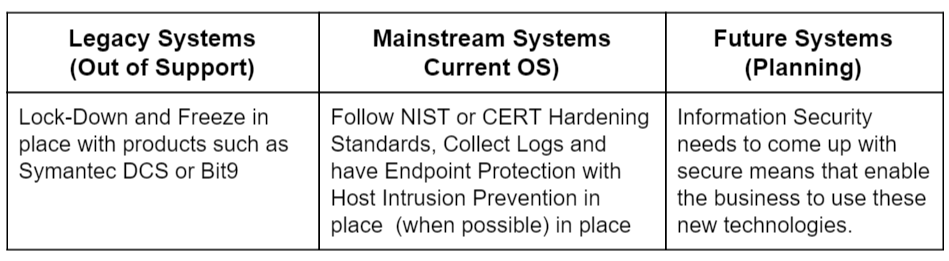
     Information Security professionals working in Critical Manufacturing should take the approach shown in Table 1 for dealing with the Computer Systems residing in the factory environment and that are on the plant floor.  By following this methodology the legacy systems will be protected while at the same time be able to continue doing the job they are good at and that they were purchased to do.  In most cases this approach will also reduce the overall risk that these systems pose to an acceptable level.

Legacy TableTable 1

This approach when combined with the network segmentation and smart firewall approach discussed in my previous blog on Critical Manufacturing is the start of a successful recipe in securing a Critical Manufacturing environment.

Information Security Defense in Depth Part 2 – A Bit More Technical View

Still for foundation level folks but a bit more technical view of Defense in Depth than last week’s post.


Critical Manufacturing Cyber Security Defense Program – A Starting Look

Cyber security professionals  are often tasked with trying to defend more than they have the resources to defend. This is especially true in the area of Critical Manufacturing as there tends to be a strong desire to protect everything.  In many cases when we try to protect everything we end up protecting nothing.  A Cyber Security Defense Program (CSDP) needs to be very focused and strategically deployed to protect the systems and areas which need protected.

Critical Manufacturing as defined by the Department of Homeland Security(DHS) is primary metal, machinery, medical, electrical and transportation.   Primary metal is Iron, Steel, Aluminum non-Feros metals;  medical includes facilities and devices, machinery is engines, turbines and power transmission, within electrical is electrical equipment manufacturing, transportation is :  vehicle, aviation and aerospace parts and vehicle manufacturing and railroad rolling stock.   Products made by these are essential to critical infrastructure sectors. The Critical Manufacturing sector focuses identification, assessment, prioritization and protection of nationally significant manufacturing industries within the given sector that may be susceptible to manmade or natural disasters.  This area is one that is critically in need of a strong CSDP.   The discipline for CSDP must not be twisted to taint what should be a strategic approach to the industrial base (“Critical Capabilities At Risk,” 2009).

One critical component to the protection of a Critical Manufacturing environment is that of using next generation, aka smart, firewalls with intrusion prevention and with some form  of malware  prevention and detection, updated via global feeds, enabled. This firewall environment should be set up in such a way as to segment the Critical Manufacturing infrastructure. Each individual plant or factory within the Critical Manufacturing environment should be on their own local area network (LAN) segment. A very basic way of thinking about this is captured in Figure 1 below.

Manufacturing Network Segmentation

Figure 1

Because of the method in which business decisions are made for factory systems it is critical that organizations involved in Critical Manufacturing use strongly firewalled network segmentation methods to ensure that each of their factory sites sit behind their own firewalls and on their own network segment (DHS, 2009).  This allows better control of the environment and enables the isolation of one factory without impacting the rest of the factories owned by the organization.  In this way if one factory is compromised by a hacker or group of hackers it can be removed and isolated from the organization’s global IT infrastructure.  Network segmentation, also called Network Control (NC) is a primary bastion for a defense in depth strategy and it can also be used to help prevent a blackhat from pivoting from a relatively unsecure factory system to a core business system.  Combining an Intrusion Prevention Appliance (IPS) or functionality with the firewall inside of a network segment provides a strong front line of perimeter defense for factories involved in Critical Manufacturing.  These IPS’ do not have to be overly tweaked and analyzed to be effective, running them in default signature mode is an adequate layer of defense for the network segment protecting and controlling a factory environment (DHS, 2009).